Most UAE small businesses that lose data were not without a backup. They had one copy on an ageing NAS in the office, on the same network as the files it protected. Drive failure, silent corruption or ransomware reached both at once. A tested, layered backup with an offsite immutable copy prevents that, at small-business cost.
The backup that was not a backup
A typical small business in Dubai or Sharjah buys a two-bay or four-bay NAS, maps it as a shared drive and sets a nightly copy of the accounts folder. For years nothing goes wrong, and the NAS quietly becomes the place where everything lives: invoices, contracts, designs, payroll exports, scanned trade licences.
That is the problem. The NAS is now both the primary store and the backup. It sits in the same room, on the same power circuit and on the same network as the computers it protects, and it is usually reachable with the same administrator password. When it fails, there is no second copy.
The business does not find this out from an audit. It finds out the morning the shared drive will not open, and an IT technician explains that the RAID volume has failed or the files now end in an unfamiliar extension.
Four ways small businesses lose data on an old NAS
1. Drives wear out, and RAID is not a backup
Hard drives fail with age, and the trend is measurable. Backblaze, which publishes failure data from the drives in its own data centres, reported a fleet-wide annualised failure rate of 1.36% for 2025. In the same report, one 8 TB model reached a 10.29% failure rate in the fourth quarter at around seven and a half years old, and was earmarked for retirement.
A small-business NAS rarely gets that kind of monitoring. Its drives were often bought together, from the same batch, and have run continuously since installation. When one fails, the rebuild puts the remaining ageing drives under sustained load, which is exactly when a second failure is most damaging. RAID keeps a system running through one disk failure. It does not protect against a second, against deletion, or against anything that writes bad data to every disk at once.
2. Silent corruption and failed updates
Not every loss announces itself. File-system corruption after a power cut, a firmware update interrupted halfway, or a failing controller can damage files for weeks before anyone opens the folder that matters. If the nightly backup job copies the damaged files over the good ones, the backup is corrupted too.
The fix is versioned backups that keep earlier copies, and regular test restores that prove the data can actually be read back.
3. Ransomware that targets NAS devices directly
NAS devices are an attractive target because they hold everything and are often exposed to the internet for remote access. QNAP has issued repeated advisories about the DeadBolt ransomware campaign, which encrypted internet-exposed NAS devices and demanded payment for the key. Its own recommendations were to disable router port forwarding, update firmware, use strong passwords, and take snapshots and back up regularly.
Synology has warned of a different route in: brute-force attacks that stole administrator credentials and then encrypted the data, without exploiting any software flaw at all. Weak passwords were enough.
Ransomware on a user's laptop is just as dangerous. If the NAS is a mapped drive, the malware encrypts it like any other folder. Verizon's 2025 Data Breach Investigations Report found ransomware present in 88% of breaches at small and medium-sized businesses, against 39% at large organisations.
4. Backups that are attacked, or never tested
Attackers know that a good backup removes their leverage, so they look for it first. Sophos's State of Ransomware 2025 survey found that only 54% of organisations hit by ransomware restored their data from backups, the lowest rate in six years. The same survey found that 63% of victims named resourcing problems, including a lack of expertise, as a factor in the attack succeeding.
That second figure matters to a small business. The technology to prevent most of these losses is not exotic. What is usually missing is someone who designs the backup properly, keeps it patched, watches it every day and proves it restores.
What it costs when the backup fails
The direct cost is the data itself: the months of accounts, the client files, the drawings that cannot be recreated. The indirect cost is downtime, staff who cannot work, and customers who are told their records are gone.
For larger organisations, IBM puts a figure on it. Its Cost of a Data Breach 2025 Middle East findings put the average breach cost in the region at SAR 27 million, down 18% on the previous year. A small business will not face numbers of that size, but it also has far less room to absorb a week without its files.
The UAE threat level is not theoretical either. The UAE Cyber Security Council has said the country faces more than 200,000 cyberattacks a day. Automated scanning does not check company size before trying a NAS login page.
What is different in the UAE
Three things make backup a sharper issue for a UAE business than the global guidance suggests.
The law now covers personal data. The UAE Personal Data Protection Law, Federal Decree-Law No. 45 of 2021, applies to organisations processing personal data in the UAE and expects that data to be protected with appropriate technical and organisational measures. Customer records, employee files and passport copies on an unprotected NAS are exactly what those measures are meant to cover. Free zones such as DIFC and ADGM have their own data protection regimes, so check which applies to you.
Where the offsite copy lives matters. If you send backups to the cloud, know which country the storage is in and whether that suits your contracts and the data you hold. A good provider will tell you plainly.
The office environment is hard on hardware. Many small offices keep the NAS in a cupboard or under a desk, without dedicated cooling, through a UAE summer, often on the same circuit as everything else and without a UPS. Drive makers publish operating temperature ranges for a reason, and a power cut mid-write is a common cause of corruption.
The layered strategy that prevents it
The answer is not to throw the NAS away. A NAS is a fast, sensible local copy. The answer is to stop treating it as the only one, and to protect the computers around it.
Follow the 3-2-1 rule, then go further
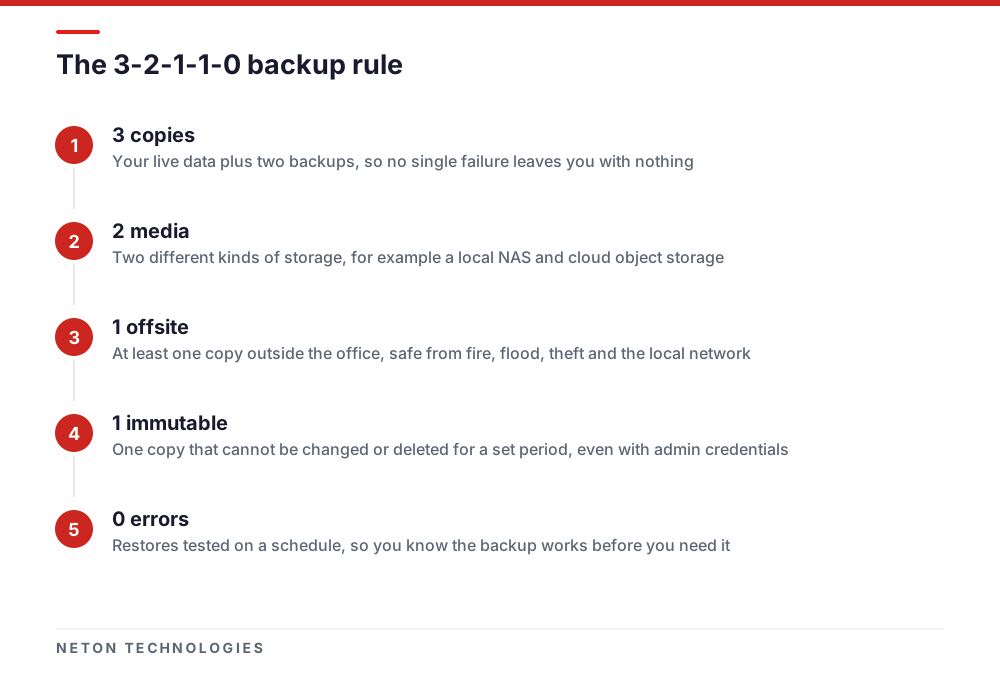
The US Cybersecurity and Infrastructure Security Agency recommends the 3-2-1 rule for small businesses: three copies of important data, on two different types of storage, with one copy kept offsite. The current best practice adds two more steps, summarised in the graphic further down this page: one copy that is immutable or offline, and zero errors on regular restore tests.
Use backup software built for it
Iperius Backup, from our partner Iperius, backs up files, servers, databases and virtual machines to NAS, USB, network shares and cloud storage from one console. Iperius supports incremental and image backups, encryption and multiple cloud destinations, so the same job that writes to the NAS can also send a copy offsite.
Jotelulu, our cloud platform partner, provides cloud servers, file storage and object storage built for small businesses and the IT providers who serve them. It gives the offsite copy a professional home rather than a personal cloud account.
Protect the endpoints, because that is where attacks start
Backup recovers you after an attack. Endpoint security stops many attacks from starting. ESET PROTECT includes a Ransomware Shield that evaluates running applications by behaviour and reputation and blocks those that act like ransomware, managed centrally so you are not relying on each user to keep antivirus up to date.
Stop data walking out of the business
Not every loss is a failure or an attack. Files leave through personal email, USB sticks and unsanctioned cloud uploads. Safetica provides data loss prevention for small and mid-sized businesses, classifying sensitive data and controlling how it moves across email, web, devices and network shares.
Have someone accountable for it
Tools do not run themselves. Someone has to set retention, separate the backup credentials from everyday logins, watch the alerts every morning, replace drives before they fail and run the test restores. That is the part an under-resourced provider skips, and it is the part that decides whether a backup restores. Our IT support for Dubai SMEs and IT infrastructure and AMC services cover exactly this ongoing work, and our wider guide to cybersecurity for UAE businesses sets out the threats behind it.
Questions to ask your IT provider this week
You do not need to be technical to find out whether your backup would survive a bad day. Ask whoever looks after your IT:
- Where are our backup copies, and is at least one of them outside the office?
- Could ransomware on one of our laptops reach and encrypt the backups?
- Is any backup copy immutable, so it cannot be deleted even with an admin password?
- When did you last restore a file or a whole system from backup, and can I see the result?
- How old are the drives in our NAS, and how do you monitor their health?
- Who is alerted if a backup job fails tonight, and how quickly do they act?
If the answers are vague, the backup is a hope rather than a plan. A provider with trained engineers will answer each one in a sentence and show you the evidence.
Enterprise-grade protection without the enterprise budget
The good news is that the gap between small-business and enterprise backup is now about design and discipline, not cost. Backup software, cloud infrastructure in the UAE and endpoint security are licensed per device or per volume of data, so a ten-person office can run the same layered approach as a large company, sized to what it actually holds.
NETON designs, deploys and monitors that approach for small and mid-sized businesses across the UAE, using Iperius, Jotelulu, ESET and Safetica. The aim is simple: when something goes wrong, and eventually something will, you restore your data in hours instead of discovering it is gone.
An ad-hoc NAS backup compared with a managed, layered backup
| Area | Typical ad-hoc NAS setup | Managed layered backup |
|---|---|---|
| Copies | One NAS copy in the same office | Local copy plus an offsite cloud copy |
| Ransomware resistance | NAS shares mapped as drives, reachable with the same credentials | Separate backup credentials and an immutable copy attackers cannot delete |
| Drive health | Checked when something breaks | Monitored, with ageing disks replaced before they fail |
| Firmware and patches | Installed occasionally, or never | Applied on a schedule and tracked |
| Restore testing | Rarely or never done | Scheduled test restores with a written result |
| Endpoint protection | Free or expired antivirus | Managed endpoint security with ransomware detection |
| Data leakage | No visibility of what leaves the business | Data loss prevention policies on email, USB and cloud uploads |
| Accountability | Whoever set it up, if they are still around | A named provider, monitoring and alerts |
Frequently asked questions
Is a NAS a backup?
A NAS is storage, and it becomes one part of a backup only when the data on it is also copied somewhere else. If your NAS holds the only copy of your files, or the only backup copy in the same office, one failure, fire or ransomware attack can take everything.
How long do NAS hard drives last?
There is no fixed lifespan, but failure rates climb with age. Backblaze's fleet data shows most drives perform well for several years, while some models reach double-digit annual failure rates at around seven years. Plan to monitor drive health and replace disks before they become the weak point.
Can ransomware encrypt my NAS backups?
Yes. If the NAS is reachable from infected computers, for example as a mapped drive, or uses the same administrator credentials as the rest of your network, ransomware can encrypt or delete the backups along with the live files. An offline or immutable copy is the protection against this.
Does UAE law require my business to back up data?
The UAE Personal Data Protection Law, Federal Decree-Law No. 45 of 2021, requires businesses that process personal data to protect it with appropriate technical and organisational measures. Losing customer or employee records through poor backup and security practice is the kind of failure those measures are meant to prevent. Take legal advice for your specific obligations.
Is enterprise-grade backup affordable for a small business?
Yes. Backup software, cloud object storage and endpoint security are now sold per device or per volume of data, so a small business pays for what it uses rather than buying enterprise hardware. The cost that matters is the design and the monitoring, which is where an experienced IT partner earns its fee.
How often should backups be tested?
Test restores on a schedule, not only after an incident. A practical starting point is a monthly test restore of sample files and a full recovery test of a critical system at least twice a year, with the result written down.
Sources
- Backblaze Drive Stats for 2025 — Backblaze — 2026-02
- The State of Ransomware 2025 (whitepaper) — Sophos — 2025-06
- 2025 Data Breach Investigations Report — Verizon Business — 2025-04
- Cost of a Data Breach 2025: Middle East findings — IBM — 2025-07
- DeadBolt Ransomware - Security Advisory — QNAP — 2022-09
- Synology urges all users to take immediate action to protect data from ransomware attack — Synology — 2019-07
- Back Up Business Data — CISA — 2025
- Data protection laws — UAE Government portal — 2025
- UAE faces 200,000+ daily cyberattacks, says Cyber Security Council — TECHx Media — 2025
- Iperius Backup for Windows — Iperius — 2026
- Jotelulu platform — Jotelulu — 2026
- Ransomware Shield — ESET — 2026
- Safetica ONE product overview — Safetica — 2026
Find out whether your current backup would actually restore
Phone: +971 4 439 5754 | WhatsApp: +971 4 542 3229
Get a Free Consultation