Teams Phone is the licence. Calling Plans, Operator Connect, Teams Phone Mobile and Direct Routing are the four ways to attach it to the public phone network. In the UAE, Direct Routing is the option that works, because the other three depend on a carrier arrangement Microsoft does not have here.
The licence and the connection are two separate decisions
Teams Phone is a licence. It turns on the calling features inside Teams: a dial pad, call handling, voicemail, hold and transfer. It does not, by itself, give anyone a phone number or the ability to call outside the organisation. That comes from a second decision, made separately, about how Teams reaches the public network.
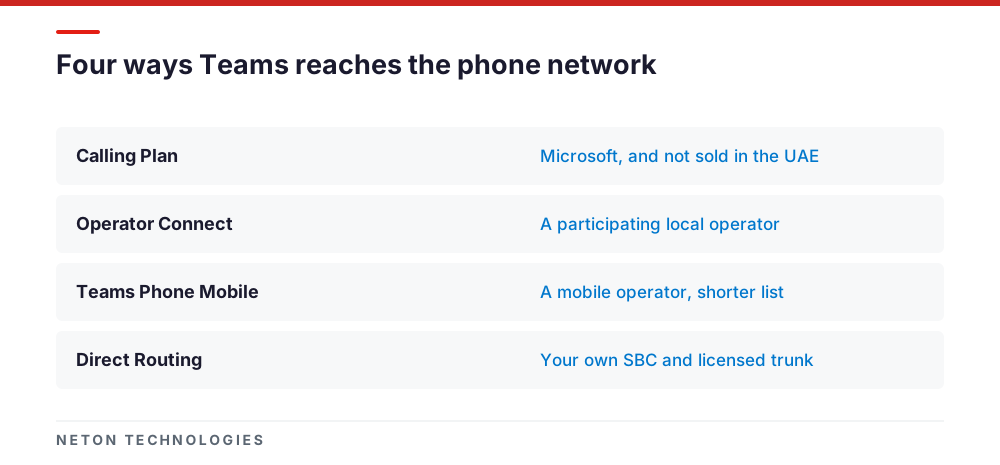
Microsoft documents four ways to make that connection in its PSTN connectivity options: a Calling Plan, Operator Connect, Teams Phone Mobile, and Direct Routing. Comparisons written for the US or Western Europe treat these as four alternatives on a menu. In the UAE they are not, and the reason is the same in each case: three of the four require a carrier relationship that has to exist in your country.
Why two of the four are simply unavailable
A Calling Plan makes Microsoft your telecom carrier. For that to work, Microsoft has to hold numbering and interconnect rights in the market. In the UAE it does not, and the UAE is correspondingly absent from the Calling Plan country and region availability list. No amount of licensing changes this; it is a regulatory position, not a product tier.
Operator Connect moves that role to a local operator, who provisions numbers into your tenant and holds the carrier contract. It is genuinely the least work of the four where it exists, but it exists only where an operator has joined the programme. Microsoft publishes the participating operators in its Operator Connect planning guide, and that list is the thing to check before a UAE shortlist includes it.
Teams Phone Mobile has the same shape and a shorter list again. It makes a user's mobile number their Teams number, which is elegant for field staff, and it depends entirely on the mobile operator participating.
What that leaves
Direct Routing, which inverts the arrangement: instead of a carrier reaching into your tenant, you connect your own trunk to Teams through a session border controller you control. Because the carrier relationship stays local, it works wherever you can buy a trunk, which is why it is the normal route across the UAE and the wider Gulf. The mechanics are covered in detail on our page on Teams Direct Routing in the UAE.
Three parts are required, and each one is a decision:
- A Teams Phone licence for every user who will make or take external calls.
Meeting and chat users do not need one, and that distinction usually makes the licence count smaller than the headcount.
Microsoft supports only devices on its certified list, and the connection procedure is specific about certificates, domains and signalling. Appliances and software both qualify; anynode as a software SBC is a common answer where rack space or a second site is the constraint.
- A licensed SIP trunk from e& or du, ordered against your trade licence. This is
routinely the longest lead time in the project and the one most often started late.
The comparison that actually matters
Once availability has removed most of the menu, the remaining question is not which option is best in the abstract. It is what each one does to your operational position.
Direct Routing gives you the most control and the most responsibility. You choose the carrier, you can move the trunk without touching the tenant, and you can route calls to systems Teams knows nothing about. You also own the SBC, its certificates and its upgrades, which is a real if modest ongoing commitment.
Operator Connect, where a market has it, trades that control for simplicity. The operator handles provisioning and the media path, and the number lives in the tenant rather than on your trunk. Moving away later means a number migration rather than a configuration change.
That trade is worth understanding before it is made, because it is easier to move between carriers under Direct Routing than to move out of an operator's tenant provisioning afterwards.
The UAE and GCC picture
The constraint generalises. Across the GCC, numbering is allocated to licensed national operators, not to software vendors, which is why the same three options fall away in Saudi Arabia, Kuwait, Bahrain, Oman and Qatar for the same reason they do here. We cover that regional pattern in local numbers across the GCC.
Two practical consequences follow for a regional rollout. Each country needs its own trunk and its own carrier contract, so a single Teams tenant serving five markets still means five carrier arrangements behind it. And the SBC design has to account for where media lands, because routing a Riyadh call through a Dubai SBC has both a latency and a licensing dimension.
If any part of the deployment will make outbound promotional calls, the UAE telemarketing rules apply on top of all of this, and most of what they require is configuration in the platform rather than a policy document.
Getting the sequence right
The order in which these decisions are made determines how the project runs. Licences can be bought in an afternoon; a trunk cannot. Working backwards from the trunk order, rather than forwards from the licence purchase, is the single change that most often keeps a Teams voice cutover on its original date.
Three things are worth proving before the switch rather than after it. Test inbound and outbound on a single pilot number through the real trunk, not a lab one, because caller ID presentation and dial-plan quirks only surface on the live carrier. Test what happens to calls when the SBC is unreachable, since the failure most users notice is not a dropped call but a number that rings nowhere. And confirm emergency calling behaves as expected from each site, which depends on how the trunk presents location and is the one test nobody wants to discover they skipped.
If the wider question is which platform to run at all rather than how to connect Teams to a number, that decision sits one level up, in what UCaaS covers and what is buyable in this market.
The four options, and what each requires from a UAE buyer
| Option | Who is the carrier | What you supply | UAE position |
|---|---|---|---|
| Calling Plan | Microsoft | Nothing beyond licences | Not available - the UAE is not on Microsoft's Calling Plan country list |
| Operator Connect | A participating operator | A contract with that operator | Only if a UAE operator appears on Microsoft's list - check it before shortlisting |
| Teams Phone Mobile | A participating mobile operator | Eligible mobile subscriptions | Same dependency, and the operator list is shorter again |
| Direct Routing | Your own e& or du trunk | A certified SBC, the trunk, and voice routing configuration | Supported and the normal route here |
Frequently asked questions
Is Teams Phone the same as Direct Routing?
No. Teams Phone is the licence that turns on calling features in Teams. Direct Routing is one of four ways to connect that licence to the public phone network. You need the licence whichever connection method you use.
Why can I not buy a Microsoft Calling Plan in the UAE?
A Calling Plan makes Microsoft your telecom carrier, which requires Microsoft to hold numbering and interconnect rights in the country. It does not in the UAE, where numbers are issued by e& and du against a trade licence, so the UAE is absent from Microsoft's Calling Plan availability list.
Can we use Operator Connect in the UAE?
Only if a UAE operator is listed as an Operator Connect partner at the time you buy. The programme depends on the carrier joining it, so the answer changes by market and over time. Check Microsoft's current operator list rather than assuming.
Do we need an SBC for Direct Routing?
Yes, and it must be on Microsoft's certified list. The SBC sits between Teams and your SIP trunk, handling signalling and media so the two sides interoperate. It can be an appliance or software running on your own infrastructure.
Can we keep our existing UAE numbers?
Yes. Direct Routing points your existing e& or du trunk at Teams, so the numbers on your invoices and signage stay the same. That is usually the deciding advantage over any model that would issue new numbers.
Which licence do users need?
Teams Phone, either as a standalone add-on or bundled in a suite such as E5. Users who only join meetings and chat do not need it; only those making and receiving external calls do, which is often a smaller group than expected.
Sources
- PSTN connectivity options — Microsoft Learn — 2026
- Country and region availability for Audio Conferencing and Calling Plans — Microsoft Learn — 2026
- Plan Direct Routing — Microsoft Learn — 2026
- Connect your Session Border Controller to Direct Routing — Microsoft Learn — 2026
- List of Session Border Controllers certified for Direct Routing — Microsoft Learn — 2026
- Plan for Operator Connect — Microsoft Learn — 2026
- Plan for Teams Phone Mobile — Microsoft Learn — 2026
- Microsoft Teams add-on licensing — Microsoft Learn — 2026
- Telecommunications and Digital Government Regulatory Authority — TDRA — 2026
- Business solutions - e& UAE — e& UAE — 2026
Connecting Microsoft Teams to a UAE phone number
Phone: +971 4 439 5754 | WhatsApp: +971 4 542 3229
Get a Free Consultation