A SIP trunk is a voice connection from a licensed carrier that delivers your phone numbers and call capacity over an IP link instead of copper lines. Your PBX or UCaaS platform connects to it directly. In the UAE you order it from e& or du against a trade licence, not online from a global provider.
What a SIP trunk actually is
A SIP trunk is a service, not a cable. Your carrier gives you a set of phone numbers and a number of simultaneous call channels, and delivers both to your phone system as SIP signalling and voice packets over an IP connection. The phone system sees one logical "trunk" where it used to see a bundle of physical lines.
Two protocols do the work. SIP, defined in RFC 3261, sets calls up, changes them and ends them: who is calling whom, which codec to use, when the call is answered. The voice itself travels separately as RTP, defined in RFC 3550. That split matters later, because signalling and media can take different paths through your network and each needs its own firewall and quality planning.
The carrier side of a trunk is the same whether the thing connecting to it is an on-premise IP PBX, a cloud platform such as Wildix, or Microsoft Teams. That is why the trunk decision and the platform decision can, and usually should, be made separately.
What it replaces, and why that matters
Most UAE businesses that ask about SIP are not starting from nothing. They are running analogue lines or an ISDN 30 circuit into an existing PBX, and the question is really whether to move.
The structural difference is the unit of capacity. An analogue line carries one call. An ISDN 30 circuit carries 30, fixed. A SIP trunk carries however many channels you order, and the number can change without anyone visiting the building. du, for example, publishes its Business SIP Trunk in tiers from 10 to 100 channels and lets customers add channels and numbers later.
The second difference is the interface. A modern IP PBX or UCaaS platform speaks SIP natively, so the trunk connects without a gateway. An older PBX may need a PRI card replaced or a media gateway added, which is often the moment a business considers a wider PBX upgrade instead.
Migration paths are carrier-specific. du's SIP trunk page states that only its ISDN 30 service can be transferred to SIP, with the ISDN line deactivated as the trunk is activated. Plan the cutover around that, not around a parallel run you may not get.
The UAE procurement path
This is the part global explainers get wrong for this market. In the US or UK you can sign up for a SIP trunk online, pay by card and have numbers in minutes. In the UAE you cannot, and the reason is regulatory rather than commercial.
TDRA's position is set out in its published FAQs: VoIP services are telecommunications services, licensees may provide them, and third parties may do so only together with a licensee or with TDRA approval. The same FAQs name the two telecommunications licensees, Etisalat (now e&) and du. A trunk carrying UAE numbers to the public network is therefore a product of one of those two carriers.
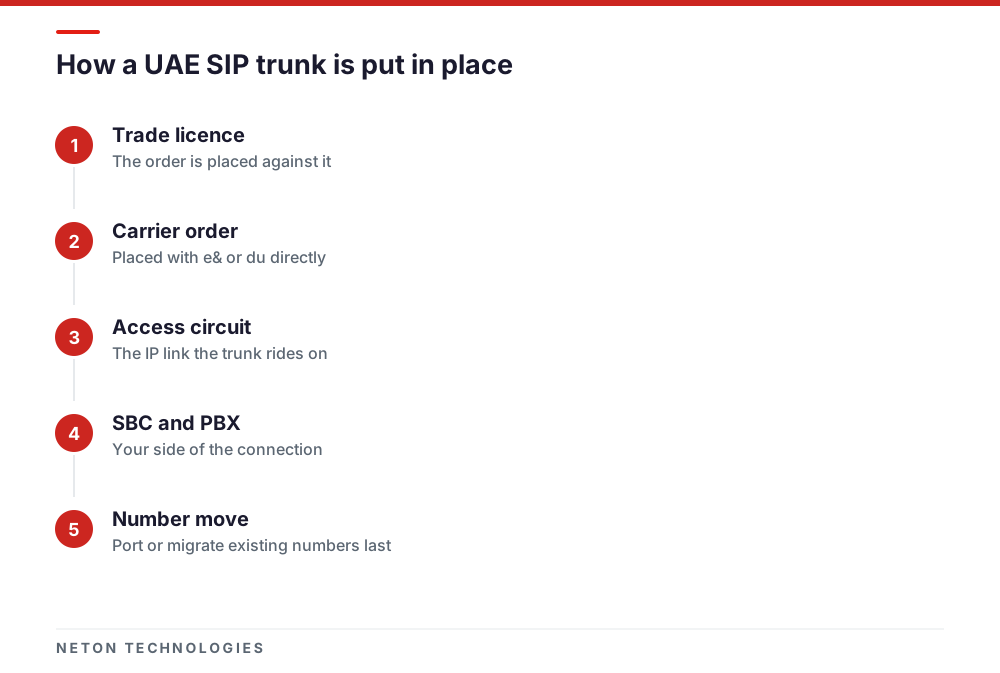
In practice that means:
- You order against your trade licence. The carrier needs to know the legal entity
the numbers belong to. du's page directs new customers to a store with the required documents and existing customers to their account manager.
- You buy from e& or du directly, or through their authorised business channels.
e& lists SIP trunking within its enterprise unified communications portfolio; du lists it alongside its other business voice products, including fixed number portability.
- You supply the phone system. du states plainly that it does not provide the PBX
or the handsets. The trunk ends at your edge, and everything behind it is yours to choose and configure.
- Lead time is set by the carrier, not the technology. The order, the access
circuit it rides on and any number migration are the long items. Start them first.
An overseas trunk with a UAE presence on paper does not solve this. Calling patterns, number presentation and whether the service is permitted at all depend on the licence behind it, so ask any provider which UAE licensee carries the traffic before you sign.
What sits between the trunk and your phone system
The trunk delivers calls to your network edge. What receives them depends on the platform.
A cloud or on-premise PBX can usually register with the carrier directly. Wildix, for example, documents the fields its system needs from the carrier (authentication login, from-user and from-domain among them) in its trunk settings guide.
Microsoft Teams cannot. Teams Direct Routing in the UAE requires a session border controller between the trunk and Microsoft's cloud, and Microsoft supports only devices on its certified SBC list. Its Direct Routing planning guide treats the SBC, its public certificate and its domain as prerequisites, not options.
Even where it is not mandatory, an SBC is often worth having. It hides the PBX from the carrier network, normalises the small SIP differences between vendors, and gives you one place to apply call limits if credentials are ever misused.
Sizing a trunk without guessing
Channels are the capacity decision, and the most common mistake is sizing them on headcount. One channel carries one simultaneous external call. A 60-person office where most people are on the phone at once needs more channels than a 200-person office where few are.
Size on evidence instead:
- Pull a month of call logs from the current system and find the peak number of
simultaneous external calls.
- Add the hidden consumers. Calls waiting in a queue, calls being transferred out,
and forwarded calls to mobiles each hold a channel, sometimes two.
- Leave headroom for the busy day, not the average one: month end for a finance
team, a campaign launch for a sales floor.
- Order numbers separately from channels. Direct-dial numbers for every desk do
not need a channel each; du's tiers, for instance, include far more numbers than channels.
Because channels can be added on the account, under-sizing slightly and growing is cheaper than over-sizing and paying for idle capacity for the length of a contract.
Resilience: what happens when the link goes down
A SIP trunk inherits the reliability of the connection it runs on. With ISDN, the circuit was the service. With SIP, there are now two things that can fail: the access link and the trunk service itself.
Three questions to settle before go-live:
- What does the trunk run over? Ask the carrier whether it needs a dedicated or
private access circuit, and whether a second link can carry it.
- Where do calls go if your site is unreachable? Most carriers can divert inbound
calls to another number or site on failure. Configure it and test it; the failure users notice is a number that rings nowhere.
- Is there a second trunk? For a contact centre or any site where the phone is the
business, a second trunk, ideally on separate access, is the normal design.
Where SIP trunks fit across the GCC
The pattern repeats across the region. Numbering in Saudi Arabia, Oman, Kuwait, Bahrain and Qatar is also allocated to licensed national operators, so a business with offices in several GCC countries needs a trunk, and a carrier contract, in each one. A single cloud platform can sit above all of them, but the trunks underneath stay local.
That makes the trunk the long-lead, country-by-country part of any regional voice project, and the reason it belongs at the start of the plan rather than the end.
SIP trunk compared with the lines it usually replaces
| Analogue lines | ISDN 30 (PRI) | SIP trunk | |
|---|---|---|---|
| Physical delivery | One copper pair per line | A dedicated digital circuit | Any IP link the carrier supports |
| Capacity unit | One call per line | Fixed 30 channels per circuit | Channels ordered as needed |
| Changing capacity | New line installed | Another circuit | Change on the account |
| PBX interface | FXO port or gateway | PRI card or gateway | Native on IP PBX and UCaaS platforms |
| Typical UAE fit | A handful of lines | Established on-premise PBX | New IP PBX, UCaaS, Teams Direct Routing |
Frequently asked questions
Can I buy a SIP trunk from an overseas provider and use it in the UAE?
Not for a compliant business service. TDRA treats VoIP as a telecommunications service that only licensees, or parties working with a licensee or TDRA approval, may provide. For UAE numbers and local calling, the trunk comes from e& or du.
Do I need an SBC with a SIP trunk?
Not always. Many IP PBXs connect to the carrier directly. You need one for Microsoft Teams Direct Routing, and it is good practice whenever the trunk and the PBX sit on different networks or the PBX should not face the carrier directly.
Can we keep our existing numbers when we move to SIP?
Usually, yes. If the trunk comes from the carrier that already holds your numbers, it is a migration on the same account. If you are changing carrier, ask the new carrier about fixed number portability before you sign anything.
How many channels do we need?
One channel carries one simultaneous call. Size it on your busiest hour, not on headcount, and include call recording, transfers and queues that hold a channel while a caller waits. Your current call logs are the best evidence.
Does a SIP trunk run over our normal internet connection?
It depends on how the carrier delivers it. Ask what access the trunk needs, whether it runs on a dedicated or private link, and what happens to calls if that link fails. That answer shapes your resilience plan.
Sources
- RFC 3261: SIP: Session Initiation Protocol — IETF / RFC Editor — 2002
- RFC 3550: RTP, A Transport Protocol for Real-Time Applications — IETF / RFC Editor — 2003
- Frequently asked questions — TDRA — 2026
- Telecommunications and Digital Government Regulatory Authority — TDRA — 2026
- Business SIP Trunk — du — 2026
- Business Voice — du — 2026
- Unified Communications — e& UAE — 2026
- Trunk settings - Admin Guide — Wildix — 2022
- Plan Direct Routing — Microsoft Learn — 2026
- Session Border Controllers certified for Direct Routing — Microsoft Learn — 2026
Ordering or migrating a SIP trunk in the UAE
Phone: +971 4 439 5754 | WhatsApp: +971 4 542 3229
Get a Free Consultation