UCaaS is calling, messaging, meetings and presence delivered as a subscription instead of a PBX you own. The definition is the same everywhere. What differs in the UAE is delivery: the voice half cannot be bought from the software vendor, because UAE numbers come only from e& and du under licence.
What the term actually covers
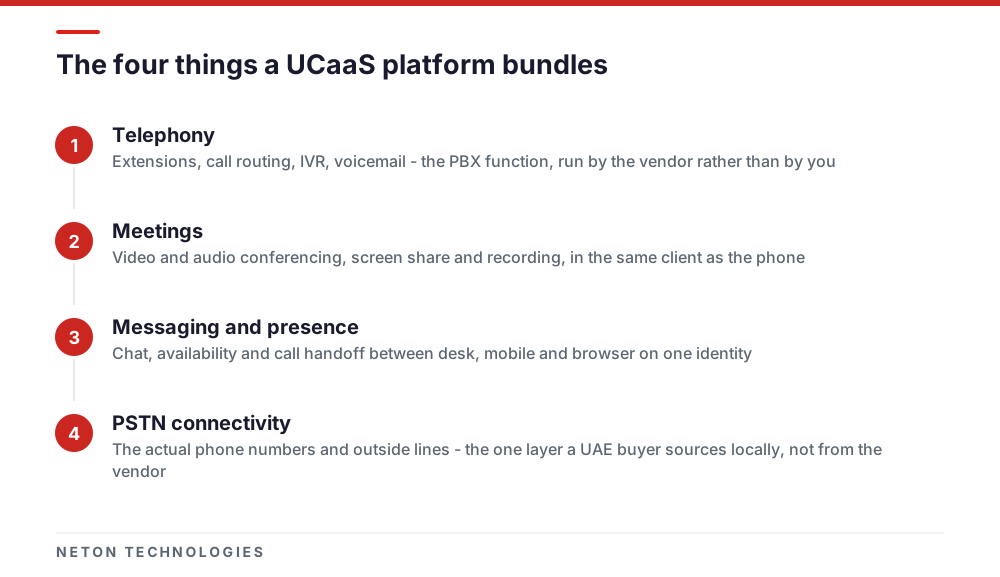
UCaaS bundles four things that used to be bought separately: the telephony system, video meetings, messaging and presence, and the outside lines that carry calls to the public network. The first three are software and travel anywhere. The fourth is national infrastructure, and that is where a UAE deployment stops resembling the brochure.
The useful way to read any UCaaS quote is to ask which of those four layers the price covers. Vendors in North America and Europe quote all four, because they can resell numbers in those markets. A quote written for the UAE covers three, and the fourth arrives on a separate invoice from e& or du.
The constraint that changes the decision
Microsoft does not sell Calling Plans for the UAE. The country and region availability list is the authoritative version of this, and the UAE is not on it. The same pattern holds across the market: a platform vendor can sell you the software from anywhere, but it cannot issue you a UAE number, because numbering is allocated to licensed operators and tied to a trade licence.
This has a practical consequence that catches out buyers who shortlist on features. Two platforms can look identical in a comparison table and differ entirely in what it takes to get dial tone. The question that separates them is not which has better presence handling. It is whether the vendor supports bring-your-own-carrier, and how well.
For Teams that path is Teams Direct Routing in the UAE: Microsoft's supported method for connecting Teams to a trunk you hold, through a session border controller that sits between the two. Microsoft's Direct Routing planning guide sets out the requirements, and only SBCs on its certified list are supported.
Operator Connect, Microsoft's third option, lets a participating carrier provision numbers into Teams directly. It is the neatest model where it exists. The programme documentation lists participating operators, and a UAE buyer should check that list rather than assume local coverage.
Legal, with one distinction that matters
Enterprise UCaaS is ordinary and permitted in the UAE. The confusion comes from consumer VoIP: TDRA restricts calling through unlicensed consumer apps on the retail internet, which is a different thing from a business platform connected to a licensed trunk. We have written separately on what UAE rules actually permit.
The distinction to hold on to is the trunk. A platform reaching the public network through an e& or du SIP trunk held under your trade licence is on the licensed side of the line. A platform routing calls over the open internet to an offshore gateway is not, regardless of how the vendor describes it. If a proposal does not name the UAE carrier the calls will traverse, that is the question to ask before anything else.
What you are actually choosing between
Once the numbering constraint is understood, the shortlist is narrower than the market appears. Wildix UC&C and Microsoft Teams with Direct Routing are the two most common answers here, both connected to a local trunk. An operator-hosted cloud PBX is a third, and a retained on-premise system remains rational where the investment is recent.
The differences worth weighing are unglamorous:
- Who holds the carrier relationship. If the platform vendor cannot, you will hold
two contracts and need someone to make them work together.
- Whether the browser client is real. A platform whose softphone is a browser rather
than an installed application changes what remote and BYOD staff can do without IT involvement.
- What happens when the internet drops. Ask what survives an outage. Some designs
fail over to mobile, some to a local gateway, some not at all.
- Whether the CRM integration is supported or bolted on. Click-to-dial and screen pop
are standard claims; a supported connector for the CRM you actually run is not.
The UAE and GCC picture
Three regional factors decide more deployments than feature comparisons do.
Numbering is local and licence-bound. Numbers come from e& or du against a trade licence. You cannot self-provision a UAE DID the way you can a US one, and a free-zone licence does not change how numbering is allocated. Plan the trunk order early; it is routinely the long pole in a cutover.
Outbound calling is regulated separately from the platform. If any part of the deployment makes promotional calls, Cabinet Resolution No. 56 of 2024 applies, and most of its obligations are configuration in the phone system rather than policy - DNCR screening, a registered caller ID, recording with notice and permitted calling hours all land on whoever configures the platform.
Regional expansion is not a licence copy-paste. Saudi Arabia, Qatar and Oman each have their own regulator and their own numbering rules. A platform that works across the GCC does so because someone arranged a carrier in each market, not because the software is portable.
Questions that separate the shortlist
Ask a prospective vendor or integrator these, and the answers will sort the list faster than any feature matrix:
- Which UAE carrier will our calls traverse, and whose name is on that contract?
- Do we keep our existing numbers, and what is the cutover plan if we do not?
- Which SBC is proposed, is it on the vendor's certified list, and who supports it?
- What is the failure behaviour when our primary internet link drops?
- Which of our systems - CRM, ticketing, ERP - has a supported integration rather than
a generic one?
- Who answers the phone at 2am, and under what response time?
A supplier who answers the first and the last of those precisely is usually worth more than one who scores better on features.
Where this leaves a buyer
UCaaS is a sound default for most UAE businesses replacing an ageing PBX. The subscription model suits organisations that add and remove staff, the browser clients suit hybrid working, and the maintenance burden moves to someone else. What does not transfer is the carrier relationship, and buyers who plan for that from the start have materially calmer deployments than those who discover it at the trunk order.
If the requirement is an agent team rather than a whole business, the answer is a different category. Contact centre platforms add queueing, skills-based routing and quality management that UCaaS does not, and choosing between them is a separate decision worth making deliberately.
Three ways to run UCaaS in the UAE, and what each one actually requires
| Model | Where the voice comes from | What you have to provide | Suits |
|---|---|---|---|
| Vendor-delivered UCaaS | The platform vendor, bundled with the licence | Not available for UAE numbers - the vendor cannot issue them | Nothing here; it is the model the brochures assume |
| UCaaS plus local SIP trunk | An e& or du trunk you hold, connected to the platform | A trunk under your trade licence, an SBC, and someone to configure voice routing | Most UAE businesses, including Teams and Wildix deployments |
| Cloud PBX from a local operator | The operator, as one service with the numbers | Little beyond the contract; the operator owns the platform | Small sites wanting one bill and no integration work |
| On-premise PBX, retained | Your existing trunk into hardware you own | Capital, a maintenance contract and a place to put it | Sites with sunk investment or strict local-control requirements |
Frequently asked questions
What does UCaaS stand for?
Unified Communications as a Service. It means calling, video meetings, messaging and presence delivered from a vendor's cloud on a per-user subscription, instead of from a PBX your business buys and maintains.
Can I buy a full UCaaS bundle with phone numbers in the UAE?
Not from the software vendor. UAE numbers are issued only by licensed operators, e& and du, against a trade licence. You buy the platform from the vendor and the numbers and trunk locally, then connect the two.
Is UCaaS legal in the UAE?
Yes, when the calling side runs over a licensed SIP trunk. What TDRA restricts is consumer VoIP apps on the retail internet. Enterprise platforms connected to an e& or du trunk are standard and widely deployed.
What is the difference between UCaaS and a cloud PBX?
A cloud PBX is the telephony layer alone, hosted rather than on site. UCaaS is that plus meetings, chat and presence in one client and one licence. Every UCaaS platform contains a cloud PBX; not every cloud PBX is UCaaS.
Do I have to give up my existing phone numbers?
No. The usual path keeps your existing e& or du numbers and points the trunk at the new platform, so the numbers on your invoices and signage do not change. Porting between operators is a separate exercise.
How is UCaaS different from CCaaS?
UCaaS serves everyone in the business for ordinary calls and collaboration. CCaaS serves an agent team, adding queueing, skills routing, wallboards and quality management. Buying UCaaS for a contact centre is the more common of the two mistakes.
Sources
- Country and region availability for Audio Conferencing and Calling Plans — Microsoft Learn — 2026
- Plan Direct Routing — Microsoft Learn — 2026
- Teams Phone - Microsoft Teams — Microsoft Learn — 2026
- List of Session Border Controllers certified for Direct Routing — Microsoft Learn — 2026
- Operator Connect — Microsoft Learn — 2026
- Telecommunications and Digital Government Regulatory Authority — TDRA — 2026
- TDRA FAQs — TDRA — 2026
- Business solutions - e& UAE — e& UAE — 2026
- du Business — du — 2026
- Wildix Unified Communications — Wildix — 2026
Working out which UCaaS model fits your licence and carrier
Phone: +971 4 439 5754 | WhatsApp: +971 4 542 3229
Get a Free Consultation