An AI voice agent is software that answers or places phone calls, holding a real conversation through speech recognition, a language model and synthetic speech. A UAE business can use one legally, but it has to run on a licensed UAE number, and outbound marketing calls must follow the telemarketing rules on consent, DNCR, hours and disclosure.
What an AI voice agent actually is
An AI voice agent is a program that takes part in a phone call the way a person would. It listens, works out what the caller wants, answers in a natural voice, and can act on the answer: book the appointment, look up the order, update the CRM, or hand the call to a colleague. It is not an IVR menu: the caller speaks normally.
Most platforms still build that conversation from separate parts. ElevenLabs, for example, describes its agents platform as coordinating four core components: a speech-to-text model, a language model you choose, a text-to-speech model, and a turn-taking model that decides when the caller has finished speaking. Microsoft offers the other approach. Its Voice Live API wraps speech recognition, generative AI and text to speech into one speech-to-speech interface, because chaining separate modules adds engineering work and delay the caller can hear.
For a buyer the questions worth testing in a pilot are the same either way: Arabic and English coverage, how the agent handles interruptions, and what it does when it is unsure.
How it gets onto a phone call
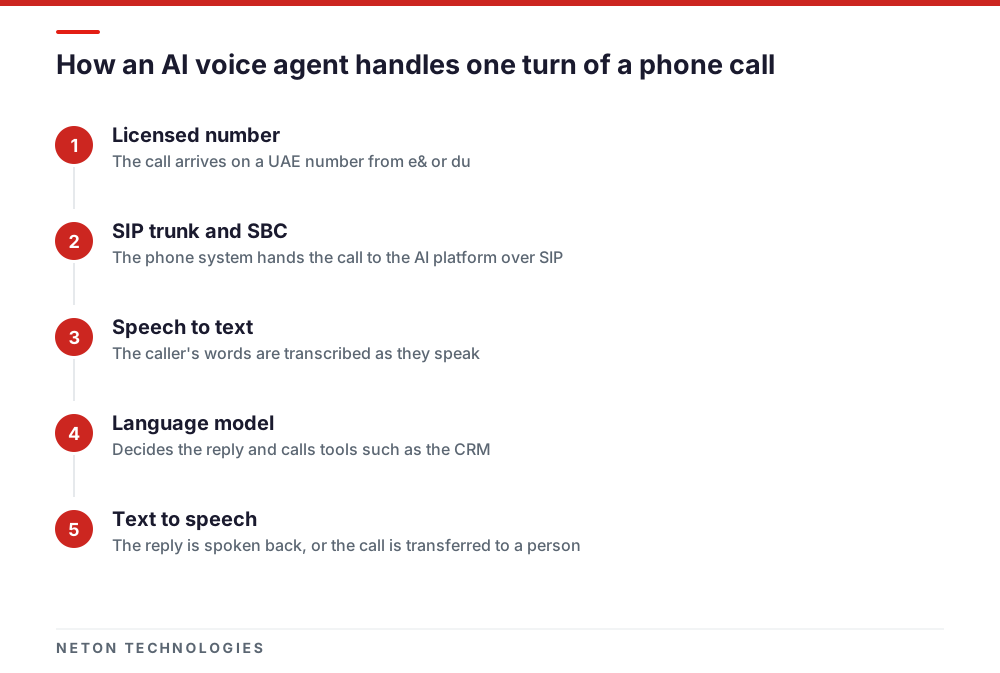
An AI voice agent does not have a phone line of its own. It connects to your telephony the same way any other system does: over SIP, from a licensed number, through your phone system or a session border controller.
The call arrives on a UAE number delivered by a SIP trunk from e& or du. Your PBX or UCaaS platform decides which calls go to the agent and passes them over SIP to the AI platform, which runs the conversation and either ends the call or transfers it back to a human queue.
The vendor documentation shows what that connection needs. ElevenLabs' SIP trunking guide asks for phone numbers in E.164 format, firewall rules that allow SIP signalling, and at least one of the G.711 or G.722 codecs. It requires TLS 1.2 or higher and recommends TLS with encrypted media.
The architecture choice that matters most is where the call lands first. If your phone system answers and then hands calls to the agent, you keep control of routing, recording, caller ID and the transfer to a person. If the AI platform sits directly on the trunk, all of that moves into a platform your telephony team may not manage. We cover the wider set of options in our article on AI telephony in the UAE.
Inbound and outbound are different legal questions
Inbound means a customer calls you and the agent answers. That is a service call. The UAE telemarketing rules are aimed at marketing calls a business initiates, and they exclude calls a consumer requested: Khaleej Times' summary of the rules notes firms are not penalised for calls the consumer asked for. What still applies is the number, the telecoms licensing, and the data protection law covering the recordings and transcripts the agent creates.
Outbound means the agent dials the customer. A reminder about an existing appointment or an overdue invoice is a service call. A call that promotes a product or service is telemarketing, and the fact that software placed it does not change that. The telemarketing rules expressly allow automated dialling systems for marketing within their conditions, according to Gulf News' report on the regulation, which means the full set of conditions applies to an AI caller.
The line is not always obvious: a renewal call that also offers an upgrade is arguably both. Decide which campaigns count as marketing with your legal adviser before the agent dials anyone.
What the telemarketing rules require of an AI caller
Cabinet Resolution No. 56 of 2024 sets the UAE telemarketing regime. It applies to every company licensed in the UAE, free zones included, and came into force on 27 August 2024, according to Clyde & Co's summary. For an outbound marketing campaign run by an AI agent, the obligations reported in that summary and in press coverage of the resolution are:
- Prior approval from the competent authority before engaging in telemarketing.
- A local number registered under your commercial licence, issued by a licensed UAE operator. Personal numbers may not be used for marketing calls.
- Calls only between 9am and 6pm, as Clyde & Co sets out.
- No calls to numbers on the Do Not Call Registry. e& states that this holds regardless of whether you have prior consent, and that you must verify a number is not registered before calling it.
- Say who you are and why you are calling. The caller should identify the company and the purpose of the call at the beginning, and ask whether the consumer wishes to continue before starting the pitch, per Gulf News.
- Recording, with notice at the start of the call. LYLAW's guide describes recording as a requirement, with the consumer informed at the outset.
- Call-back limits. No further calls after a consumer rejects the offer, and no more than once a day and twice a week where calls go unanswered, per Clyde & Co.
- Records and reporting. Detailed records of marketing calls, with regular reports to the authorities.
An AI agent can follow every one of these precisely. The opening line, the recording announcement, the hours window and the retry logic are all configuration, not habit.
The weak point is the list. An AI agent will dial an unscreened list faster than any sales floor, so DNCR screening has to sit in front of the dialler as a hard gate, not a spreadsheet someone refreshes. Our guide to DNCR and UAE telemarketing compliance covers where each control belongs in the phone system.
Enforcement is real, and it lands on the number
The rules are being enforced. TDRA reported AED 19.19 million in fines and 9,433 numbers disconnected for telemarketing violations as of June 2026, according to Khaleej Times. The penalties that sit alongside the resolution run up to AED 150,000 for a business that repeatedly calls DNCR-registered consumers, per Clyde & Co.
The operational penalty is the one that hurts an AI campaign most. Under the Voice Spam Policy that e& says applies from 1 September 2026, black points accrue against the offending number. At 5 black points the number goes onto the Do Not Originate Register and its outgoing calls are barred, with a fine of AED 5,000 per number to be paid before it comes off. At 25 black points the trade licence itself is restricted from buying telecom services and new numbers.
The lesson is architectural: give outbound campaigns their own numbers, so a misconfigured campaign cannot bar your main line.
Recordings, transcripts and the PDPL
Every AI voice call produces personal data: audio, a transcript, often a summary and CRM fields extracted from the conversation. In most of the UAE that falls under Federal Decree-Law No. 45 of 2021 on the protection of personal data, which the UAE government portal describes as prohibiting processing without the owner's consent, subject to exceptions, and setting requirements for cross-border transfers.
Clyde & Co's analysis of the law picks out the points that matter for voice AI:
- Consent must be specific, clear and unambiguous, and the law does not offer a "legitimate interests" basis. Other bases include performing a contract with the person.
- Data subjects can object to automated processing and to direct marketing.
- Cross-border transfers are permitted to countries with adequate protection, with derogations such as express consent. Many AI platforms process audio outside the UAE, so this is a live question, not a footnote.
- An impact assessment is required when using new technologies that pose a high risk to privacy.
- Exclusions: health data, banking data under its own laws, and free zones with their own regimes, such as DIFC and ADGM, follow separate rules.
Some details, including breach-notification timing and penalties, were left to executive regulations, so confirm the current position with counsel.
In practice, map the data before you sign. Audio may pass through the trunk, your phone system, the AI platform, its model providers and your CRM, and you need to be able to name where each one processes it.
What is different in the UAE
Two constraints decide most UAE AI voice projects before the AI is even chosen.
The number must come from a licensed operator. TDRA's published FAQs treat VoIP as a telecommunications service that licensees may provide, or third parties working with a licensee or holding TDRA approval, and state that international telecom providers are not licensed to provide VoIP services in the UAE. Numbers bought in a few clicks from a global AI platform are not UAE numbers from e& or du, and cannot be registered under your trade licence. The workable route is a licensed trunk into your phone system, with the AI platform connected behind it. Our page on local UAE numbers on cloud and AI platforms shows how that bridge is built.
Financial institutions have an extra layer. The Central Bank's telemarketing regulation for licensed financial institutions was published in the Official Gazette on 31 March 2026, with compliance expected by 29 June 2026, according to Pinsent Masons. It requires automated calls to connect within 2 seconds of answer, lets customers choose between a human agent, a robocall or an AI-based agent, and requires a log of telemarketing activity kept for at least 5 years. Banks and insurers should design to that standard from the start.
Across the GCC the pattern is similar even where the detail differs, so an AI deployment built on a licensed local trunk adapts more easily than one built on self-service numbers.
A checklist before you go live
- Is every number the agent answers or dials a UAE number from e& or du, delivered over a licensed trunk?
- Have you classified each use case as service or marketing, in writing?
- For marketing: do you hold the required approval, and is the outbound number registered under your commercial licence?
- Is DNCR screening a hard gate in the dialling path, rechecked on an ongoing basis?
- Does the agent's opening name your company, the purpose of the call and the recording, and ask whether to continue?
- Are calling hours and retry limits enforced by the platform, not by a prompt instruction?
- Can a caller reach a human at any point, and does the transfer carry the context with it?
- Do you know where audio, transcripts and summaries are processed and stored, and for how long?
- Have you run a data protection impact assessment and updated your privacy notice?
- Are outbound campaign numbers separate from your main business numbers?
If you are deploying on Wildix, x-bees adds call summaries and CRM logging alongside the voice channel, which helps with questions 7 and 8. NETON connects AI voice platforms to licensed UAE trunks on Wildix and Sangoma systems, with anynode SBCs where Microsoft Teams is involved, and builds the routing, recording and screening controls around them.
Inbound vs outbound AI voice agents: what applies in the UAE
| Requirement | Inbound (customer calls you) | Outbound marketing (you call them) |
|---|---|---|
| Licensed UAE number and trunk | Yes | Yes, registered under your commercial licence |
| Telemarketing approval | Not for service calls | Yes, prior approval before telemarketing |
| DNCR screening | No | Yes, before every campaign and on an ongoing basis |
| Permitted hours | Answer 24 hours a day | 09:00 to 18:00 only |
| Say company name and purpose | Good practice | Required at the start of the call |
| Recording notice | Good practice; the recording is personal data | Required, at the start of the call |
| Call-back limits | Not applicable | Once a day, twice a week if unanswered, never after a refusal |
| PDPL for recordings and transcripts | Yes | Yes |
| Route to a human | Strongly advised | Strongly advised; offered as a choice in the financial sector |
Frequently asked questions
Is it legal to use an AI voice agent to answer our customer calls in the UAE?
Yes, provided the calls reach it on a licensed UAE number through a licensed operator's service. Inbound service calls are not telemarketing, so the DNCR and calling-hours rules do not bite. You still need a lawful basis and proper controls for any recordings and transcripts under the UAE data protection law.
Can an AI voice agent make sales calls to UAE numbers?
It can, but an automated sales call is treated as a telemarketing call. That means prior approval, DNCR screening, a local number registered to your commercial licence, calls only between 9am and 6pm, and an opening that names your company and the purpose of the call. Confirm the detail for your sector with counsel.
Do we have to tell callers they are speaking to an AI?
The general telemarketing rules require you to name the company and the purpose of the call, but published summaries do not spell out an AI disclosure. Central Bank rules for financial institutions let customers choose a human, a robocall or an AI agent. Saying it plainly at the start is the safer design.
Can we connect an AI voice platform to a number bought from an overseas provider?
Not for a compliant UAE business line. TDRA treats VoIP as a telecommunications service that licensees, or parties working with a licensee or holding TDRA approval, may provide, and it states that international telecom providers are not licensed to provide VoIP here. The number and trunk should come from e& or du.
Where are AI voice agent recordings and transcripts stored?
Wherever the AI platform and your phone system put them, which may be outside the UAE. The PDPL sets conditions on cross-border transfers of personal data, and some sectors and free zones have their own rules. Ask every vendor in the chain where audio, transcripts and model inputs are processed and kept.
Sources
- UAE tightens telemarketing regulations: what you need to know — Clyde & Co — 2024-07
- Fines up to Dh150,000: UAE implements strict new telemarketing rules — Gulf News — 2024-06
- New telemarketing rules in UAE: timings, fines, exemptions explained — Khaleej Times — 2024-06
- Dh19 million in fines issued, 9,433 numbers cut in UAE for telemarketing violations — Khaleej Times — 2026-08
- Telemarketing rules set for UAE financial institutions — Pinsent Masons Out-Law — 2026
- Do Not Call Registry (DNCR) — e& UAE — 2026
- Frequently asked questions — TDRA — 2026
- Data protection laws — UAE Government portal (u.ae) — 2026
- UAE issues landmark personal data protection law — Clyde & Co — 2021-11
- ElevenLabs Agents platform overview — ElevenLabs — 2026
- SIP trunking — ElevenLabs — 2026
- Voice Live API overview — Microsoft Learn — 2026-10
- Telemarketing Regulations in the UAE — LYLAW — 2026-10
Putting an AI voice agent on a UAE number
Phone: +971 4 439 5754 | WhatsApp: +971 4 542 3229
Get a Free Consultation