UAE e-invoicing becomes mandatory for business-to-business and business-to-government invoices in phases. Businesses with revenue of AED 50 million or more go live on 1 January 2027, smaller businesses on 1 July 2027 and government entities on 1 October 2027. Invoices travel as structured data through an Accredited Service Provider, and Odoo connects to that provider.
What UAE e-invoicing actually is
A UAE e-invoice is not a PDF. It is invoice data in a fixed structure, sent from your system to your customer's system through accredited intermediaries, with a copy of the tax data reported to the Federal Tax Authority (FTA). The Ministry of Finance says plainly that PDF, Word, images, scanned copies and emails are not e-invoices.
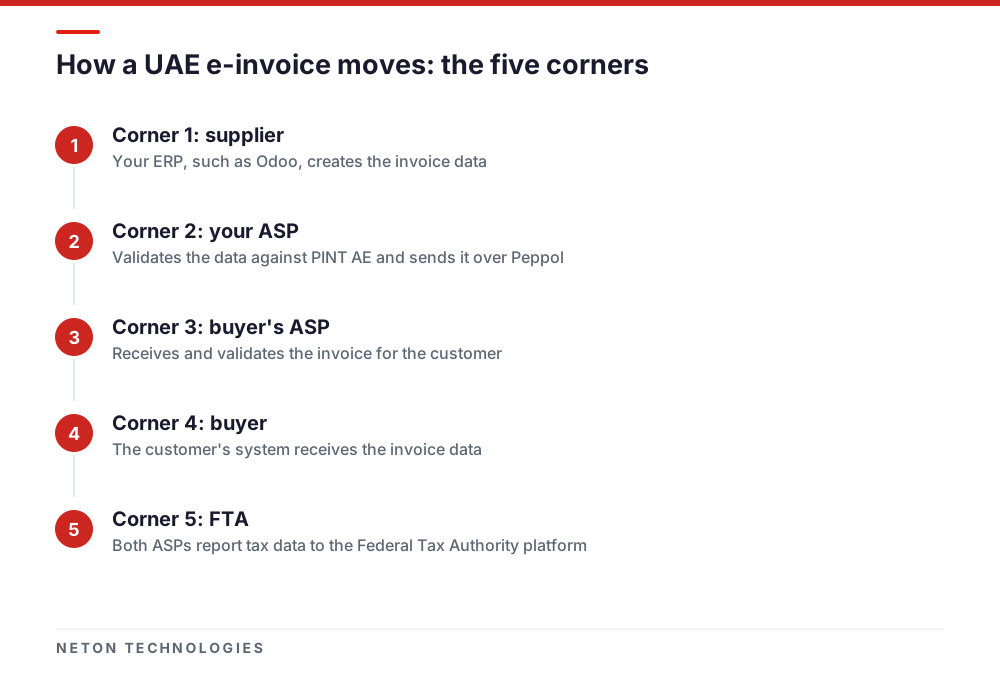
The UAE has chosen what the Ministry calls a five-corner model, formally Decentralized Continuous Transaction Control and Exchange:
- Corner 1 is you, the supplier. Your ERP or accounting system creates the invoice data.
- Corner 2 is your Accredited Service Provider (ASP), which validates the data and sends it over the Peppol network.
- Corner 3 is your customer's ASP, which receives and validates it.
- Corner 4 is your customer, whose system receives the invoice.
- Corner 5 is the FTA, which receives tax data reported by the ASPs.
The data format is PINT AE, the UAE version of the Peppol International invoice specification. OpenPeppol publishes it alongside a self-billing variant and the UAE Tax Data Document that ASPs use to report to the FTA. The Ministry's deck lists 51 mandatory fields for a PINT AE tax invoice, from seller and buyer electronic addresses to line-level VAT in AED.
Two operating rules change daily habits. Under Ministerial Decision No. 197 of 2026, in force from 1 October 2026, an e-invoice or e-credit note must be issued and transmitted within 14 business days of the transaction. And according to the FTA, an issued e-invoice cannot be cancelled; you correct it with a credit note.
Who must e-invoice, and by when
The answer is set by Ministerial Decision No. 244 of 2025, issued in September 2025 and amended by Ministerial Decision No. 66 of 2026 in May 2026. The amendment moved the large-business deadline to appoint an ASP from 31 July 2026 to 30 October 2026. It did not move the go-live date.
| Phase | Who | Appoint an ASP by | Implement by |
|---|---|---|---|
| Pilot and voluntary | Taxpayer Working Group invited by the Ministry; any business that opts in | Not applicable | From 1 July 2026 |
| Phase 1 | Revenue of AED 50 million or more | 30 October 2026 | 1 January 2027 |
| Phase 2 | Revenue below AED 50 million | 31 March 2027 | 1 July 2027 |
| Phase 3 | Government entities | 31 March 2027 | 1 October 2027 |
Sources: Ministerial Decision No. 244 of 2025, as amended by Ministerial Decision No. 66 of 2026; confirmed by the FTA on 25 October 2026.
Revenue means gross income in your most recent accounting period, taken from your financial statements, as the decision defines it. For a newly established company, the Ministry's roll-out slide says projected revenue for the current financial year is used.
What is outside the system, for now:
- Business-to-consumer sales. They are excluded until the Minister decides otherwise, and a business that sells only to consumers is not yet subject to the system, under Article 5 of Decision 244.
- Specific transactions listed in Decision 197 of 2026, including VAT-exempt and zero-rated financial services, certain airline transactions, and transactions between members of the same VAT tax group for 24 months from 1 January 2027.
The 30 October 2026 deadline has now passed. The FTA has said that missing an implementation or ASP-appointment deadline carries an administrative penalty of AED 5,000 for each month or part month of delay. If you are in Phase 1 and have not appointed an ASP, that is the first thing to fix. Your tax adviser should confirm which phase applies to you and how any exclusion affects your business.
What your business needs before go-live
Four things, and the software is only one of them.
An Accredited Service Provider. Every in-scope business must use an ASP to send and receive e-invoices, and the FTA says you use the same ASP for both directions. The Ministry keeps the official list of accredited providers; its October deck counted 65 accredited and 5 pre-approved providers. The deck also says businesses select and onboard their ASP through EmaraTax, the FTA's portal.
A system that can produce the data. The ASP validates and transmits, but it can only send what your system gives it. Your ERP or accounting package has to hold every mandatory field in a form a connector can read: structured addresses, tax categories per line, units of measure, payment means.
Clean master data. Every mandatory field has to come from a record somewhere, so most of the preparation is data work. Customer records need legal names, structured addresses with emirate, and a tax identifier. The Ministry's ASP guidance defines the TIN as the first 10 digits of the 15-digit TRN; the FTA says every business needs a TIN, and VAT-registered businesses also include the TRN. Products need consistent tax codes and units.
Process changes. Corrections become credit notes, the 14-business-day issue window becomes a hard limit, and your accounts payable team starts receiving supplier invoices as data rather than attachments. Records must be retained for the period set by the Tax Procedures Law, under Decision 197.
How Odoo fits
Odoo is the corner 1 system: it holds the customers, products, taxes and invoices that the e-invoice is built from. It is not the ASP, and that distinction drives every decision below.
What the UAE localisation covers. Odoo's UAE fiscal localisation (the l10n_ae module) installs a UAE chart of accounts and the FTA's VAT rates, supports reverse charge, and produces the VAT201 return and a corporate tax report. It distinguishes Tax Invoices for business customers from Simplified Tax Invoices for consumers, based on whether the customer has a TRN. That is the foundation an e-invoice is built on.
What it does not cover today. At the time of writing, Odoo's UAE localisation page does not describe PINT AE output or a connection to a UAE ASP. Odoo can act as its own Peppol access point, but its electronic invoicing documentation lists the countries eligible for that registration, and the UAE is not among them. Odoo also does not appear on the Ministry's ASP list. In UAE terms, your Odoo connects to an ASP; it does not replace one.
What that means in practice. You need a connector between Odoo and your chosen ASP. It may come from the ASP itself, from a third-party Odoo module, or from integration work against the ASP's API. Either way, the connector takes the posted invoice from Odoo, maps it to PINT AE, passes it to the ASP, and writes the delivery status back. This is software integration work, and it is where testing time goes.
Version considerations. Because the connector, not Odoo's core, does the exchange, the question to ask is which Odoo versions and editions each ASP's connector supports. An older or heavily customised installation can rule out the cleanest option. If your Odoo runs on a server in the office, decide now whether it stays there or moves to cloud hosting, since the connector will need reliable outbound access to the ASP every business day.
Questions worth asking any ASP before you sign, drawn from the Ministry's own checklist:
- Is there a supported connector for our Odoo version, and who maintains it when Odoo upgrades?
- Does the connector handle credit notes, self-billing and inbound supplier invoices, or only outbound sales invoices?
- How are validation errors returned to the accountant who posted the invoice?
- How long are e-invoices retained, and can we export them for the FTA on request?
A readiness checklist
Work through these in order. The first three are blocking.
- Confirm your phase. Take revenue from your latest financial statements and agree the phase with your tax adviser.
- Appoint an ASP. Shortlist from the Ministry's list, check Odoo connector support, sign, and onboard through EmaraTax.
- Confirm your Odoo version is supported by that ASP's connector. If not, scope the upgrade.
- Clean customer master data. Legal names, structured addresses, emirate, TRN or TIN, and the customer's Peppol electronic address where your ASP needs it.
- Clean product and tax data. One tax code per product line, consistent units of measure, no free-text tax descriptions.
- Map the mandatory fields in the Ministry's field requirements document to Odoo fields, and list the gaps.
- Install and configure the connector on a test copy of your database, not production.
- Test real scenarios: standard invoice, credit note, foreign-currency invoice, a zero-rated line, a customer with a missing TRN.
- Agree the new process for corrections, the 14-business-day window, and inbound supplier invoices.
- Go live before your deadline, not on it, and watch the first weeks of delivery statuses daily.
If you are on spreadsheets or an old accounting package
Spreadsheets and Word templates cannot produce PINT AE data, so they will not survive go-live as the system of record. You have three realistic routes.
Use the ASP's portal. If your ASP offers a web portal where invoices are keyed in directly, ask about it. For a business issuing a handful of invoices a month this can work, but it duplicates data entry and leaves your accounts disconnected from your invoices.
Upgrade the package you have. If your accounting vendor supports UAE e-invoicing for your version, or an ASP has a connector for it, an upgrade may be the shortest path. Get that confirmation in writing, with the version number.
Move to an ERP. If the package is unsupported, or your invoicing already runs across spreadsheets, CRM and accounts, e-invoicing is a reasonable point to consolidate. An Odoo implementation brings sales, invoicing, inventory and accounting into one database, which is the cleanest source for e-invoice data. The trade-off is time: a migration needs data clean-up, training and parallel running, so Phase 2 businesses starting now have more room than Phase 1 businesses do.
Whichever route you choose, the infrastructure underneath matters too. Backups, user access and a dependable internet link are part of compliance once a missed invoice has a deadline attached; that is the ground IT support for Dubai SMEs covers.
What is specific to the UAE
The UAE model combines exchange over Peppol with reporting to the FTA through the same accredited providers. A few points are local:
- Two authorities, two roles. The Ministry of Finance writes the legislation, accredits providers and acts as the UAE Peppol Authority; the FTA operates onboarding on EmaraTax and the central data platform, according to the Ministry's programme deck.
- Accreditation is local. Being a Peppol access point elsewhere does not make a provider an ASP in the UAE. Only providers on the Ministry's list qualify.
- Phasing is by revenue, not VAT status. The threshold is AED 50 million of revenue, as defined in Decision 244, so check your financial statements, not your VAT returns.
- Tax groups get time. Transactions inside a VAT tax group have a 24-month exclusion from 1 January 2027 under Decision 197, but sales to customers outside the group do not.
- The rules are still moving. The Ministry amended its decisions in May and October 2026, and the Ministry's e-invoicing page is the only official source. Check it before every milestone.
NETON has delivered projects in the UAE since 2009 and is an Odoo Certified Partner. We are not an Accredited Service Provider, and we do not give tax advice. What we do is the Odoo side: localisation, data clean-up, and the integration between Odoo and the ASP you choose.
What changes, depending on where you start
| Starting point | Can it produce structured invoice data? | Main work before go-live |
|---|---|---|
| Spreadsheets and Word or PDF invoices | No. A PDF or Word file is not an e-invoice under the UAE rules | Move invoicing into an accounting system or ERP, or use an ASP's own portal for low volumes |
| Older desktop accounting package | Depends on the vendor and version | Ask the vendor or your ASP whether a supported connector exists for your version; plan an upgrade or migration if not |
| Odoo with the UAE localisation | Holds the data the invoice needs; the PINT AE exchange runs through an ASP | Choose an ASP with an Odoo connector for your version, clean master data, test end to end |
| Other ERP (SAP, Oracle, Microsoft Dynamics) | Usually, through the vendor's or ASP's integration | Confirm the connector, map fields, test with your ASP |
Frequently asked questions
When do I have to start e-invoicing in the UAE?
It depends on your revenue. Businesses with revenue of AED 50 million or more must implement e-invoicing by 1 January 2027, businesses below that threshold by 1 July 2027, and government entities by 1 October 2027. Confirm which phase applies to you with your tax adviser.
Can Odoo send e-invoices to the FTA directly?
No. In the UAE model, invoices are exchanged and reported through an Accredited Service Provider, and Odoo is not on the Ministry of Finance's list of accredited providers. Odoo holds and prepares the invoice data, and a connector passes it to the ASP you appoint.
Is a PDF invoice sent by email still valid after go-live?
Not as an e-invoice. The Ministry of Finance states that unstructured formats such as PDF, Word, images, scans and emails are not e-invoices. You can still send a PDF copy to a customer, but the legal invoice has to travel as structured data through your Accredited Service Provider.
Does UAE e-invoicing apply to sales to consumers?
Not yet. Business-to-consumer transactions are outside the system until the Minister issues a decision bringing them in, and a business that only sells to consumers is not currently subject to it. Check the latest Ministry of Finance decisions before relying on this.
We missed the 30 October 2026 deadline to appoint an ASP. What now?
Appoint one as soon as possible and do not wait for the go-live date. The Federal Tax Authority has said that failing to appoint an ASP within the deadline is subject to an administrative penalty for each month or part month of delay. Speak to your tax adviser about your position.
Which Odoo version do I need for UAE e-invoicing?
There is no single answer, because the exchange is handled by your Accredited Service Provider's connector rather than by Odoo's core localisation. Ask each ASP which Odoo versions and editions their connector supports, and treat an unsupported version as a reason to plan the upgrade now.
Sources
- eInvoicing — UAE Ministry of Finance — 2026-11
- Ministerial Decision No. 244 of 2025 on the Implementation of the Electronic Invoicing System — UAE Ministry of Finance — 2025-09
- Ministerial Decision No. 66 of 2026 amending Ministerial Decision No. 244 of 2025 — UAE Ministry of Finance — 2026-05
- Ministerial Decision No. 197 of 2026 amending Ministerial Decision No. 243 of 2025 on the Electronic Invoicing System — UAE Ministry of Finance — 2026-10
- UAE eInvoicing Programme (introduction deck) — UAE Ministry of Finance — 2026-10
- eInvoicing Accredited Service Providers (ASPs) — UAE Ministry of Finance — 2026-11
- Considerations for Selecting an Accredited Service Provider, V1.1 — UAE Ministry of Finance — 2026-10
- UAE Electronic Invoice Mandatory Field Requirements — UAE Ministry of Finance — 2026-10
- Federal Tax Authority calls on persons subject to e-invoicing to comply with the prescribed legal deadlines — Federal Tax Authority — 2026-10
- UAE eInvoicing — Federal Tax Authority — 2026-11
- United Arab Emirates electronic document specifications (PINT AE) — OpenPeppol — 2026-07
- United Arab Emirates fiscal localisation (Odoo 19.0) — Odoo — 2026
- Electronic invoicing (EDI) (Odoo 19.0) — Odoo — 2026
Getting Odoo ready for UAE e-invoicing
Phone: +971 4 439 5754 | WhatsApp: +971 4 542 3229
Get a Free Consultation