A cloud PBX runs your phone system on a provider's servers for a subscription; an on-premise PBX runs on hardware you own at your site. For most UAE businesses, cloud is the default. On-premise or private cloud suits strict data-control rules, unreliable site connectivity, or heavy investment in existing equipment.
What is the difference between a cloud PBX and an on-premise PBX?
The difference is who owns and runs the system that handles your calls. A cloud PBX runs in a provider's data centre, and you pay a subscription and manage users through a web portal. An on-premise PBX runs on an appliance or server in your building, and you or your partner own the hardware, upgrades and security.
Everything users see can be the same in both: extensions, call queues, voicemail, call recording and mobile apps. The decision is about cost structure, control and how the system behaves when something fails. If the wider question is whether to replace the phone system with a full communications platform, start with what UCaaS covers.
Which option should a UAE business choose?
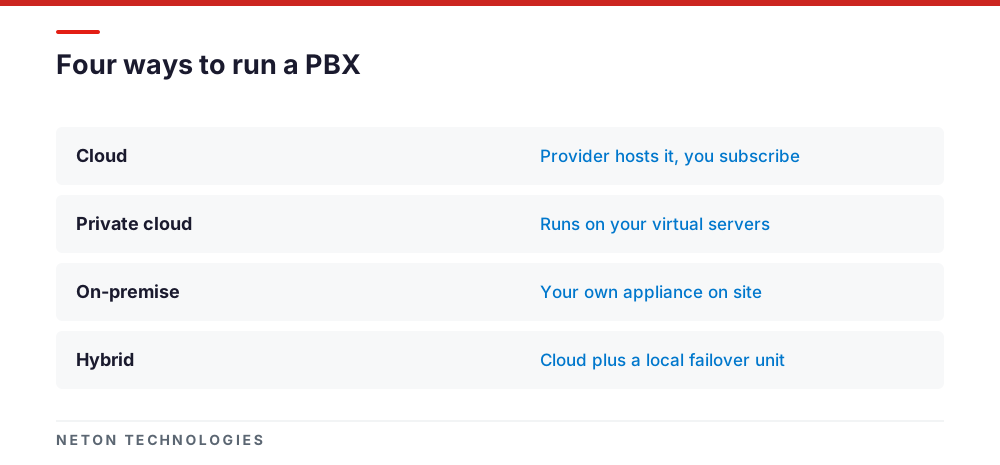
Most UAE businesses should start from cloud and move away from it only for a specific reason. Use this as the short version:
- Choose cloud if you have several sites, remote or mobile staff, a growing or
changing headcount, or no one on staff to maintain a phone system.
- Choose on-premise if the PBX is still in supported life, your headcount is stable,
and you have the skills or a partner to keep it patched.
- Choose private cloud if policy requires the system to run on infrastructure you
control, but you do not want a dedicated appliance.
- Choose hybrid if you want cloud management, but a site cannot accept losing its
phones when a link fails.
These are not all-or-nothing products. Wildix, for example, publishes all of these as options on its cloud PBX page: hosted cloud, purpose-built appliances, deployment on your own virtual infrastructure, and pairing a cloud PBX with an on-premise unit for failover.
How do the costs compare?
Cloud is an operating cost and on-premise is mainly a capital cost, and neither is automatically cheaper. Cloud removes the hardware purchase and upgrade projects, but the subscription continues for as long as you use it. On-premise needs more money upfront, but a stable system can run for years.
Compare the two over the same period, and count everything:
- Licences or subscriptions for every user who needs them
- Hardware, and its eventual replacement
- Support contracts and internal staff time
- SIP trunks and call charges, which apply to both models
- Internet capacity and any second link for resilience
One cost is easy to miss. On-premise platforms have vendor support lifecycles, and each one ends. Avaya's end of manufacturer support notice for Aura Platform 10.1, for example, took effect on 1 January 2026, while Release 10 stays on offer through version 10.2. Staying supported on any on-premise platform means budgeting for these upgrades. If you are already at that point, our guide to upgrading an ageing PBX covers the options.
How do SIP trunks work with each option in the UAE?
Both options still need a licensed carrier connection, and this is the part of the decision that is specific to the UAE. TDRA's published FAQs class VoIP as a telecommunications service and name Etisalat (now e&) and du as the telecommunications licensees. Moving the PBX to the cloud does not change who supplies your numbers.
That raises the first question to ask of any cloud proposal: where does the trunk land? du's Business SIP Trunk comes without a PBX, so the customer provides the system it connects to. e& lists SIP trunking in its enterprise unified communications portfolio. Before you sign, get both the carrier and the PBX vendor to confirm how the trunk reaches the platform, and whether anything needs to stay on site.
If you need a refresher, we explain what a SIP trunk is and how one is bought here. The same logic applies to Microsoft Teams: Teams Direct Routing in the UAE connects a local trunk to Microsoft's cloud through a session border controller, as set out in Microsoft's Direct Routing planning guide.
Does a cloud PBX keep data in the UAE?
Not necessarily, so ask for the hosting region in writing. Cloud PBX platforms run in a specific region that varies by provider, and call recordings, voicemail and call logs are stored there. A UAE region does exist on the major platforms: AWS lists a Middle East (UAE) region. That does not mean any given phone provider uses it.
The legal position needs care. The federal Personal Data Protection Law, Decree-Law No. 45 of 2021, limits transfers of personal data outside the UAE, with allowances for approved jurisdictions and other exceptions, as DLA Piper's guide to UAE data transfers explains. The same guide shows that sector rules can be stricter: health information is generally restricted from leaving the UAE, and Central Bank rules require certain payment and customer data to stay onshore.
The financial free zones are also separate. DLA Piper's UAE data protection guide notes that the DIFC and ADGM keep their own data protection laws. If you record calls in a regulated sector or a free zone, take legal advice before choosing a hosting region. Recordings of identifiable people should be treated as personal data.
Which option is more reliable?
Reliability depends on your weakest link, not on the deployment model. A cloud PBX removes the single server in your comms room, but it makes the site's internet link critical. An on-premise PBX keeps internal calling alive during an internet failure, but the server, its power and its trunk become your single points of failure.
Three protections cover most of the risk:
- A second connection on separate access, ideally from a different provider.
- Carrier-level call forwarding, so inbound calls reach a mobile or another site
when your primary site is unreachable.
- A local failover unit for sites that cannot go without phones. Wildix describes
this hybrid pairing on its cloud PBX page.
Test failure before go-live, not after. The fault users notice first is a published number that rings out.
What should you check before signing?
These questions separate a sound proposal from a brochure, whichever model you choose:
- Which UAE-licensed carrier supplies the numbers and trunk?
- Where does the trunk connect, and does anything stay on site?
- In which region are recordings, voicemail and call logs stored?
- Do softphones and mobile apps work on UAE mobile networks? Test this in a pilot,
because VoIP traffic is regulated here.
- What happens to calls during a site outage, and has it been tested?
- Who applies security patches, and how quickly?
- Can you export recordings and call data if you leave?
Cloud PBX and on-premise PBX compared
| Factor | Cloud PBX | On-premise PBX |
|---|---|---|
| Cost model | Recurring subscription, usually per user | Upfront purchase, plus support and replacement cycles |
| Who runs it | The provider runs the platform; you administer users | You or your partner run the whole system |
| Time to deploy | Short, with no server to install | Longer, with hardware to order, rack and configure |
| Scaling | Add or remove users on the account | Limited by hardware and licence capacity |
| Remote and mobile staff | Designed for it | Possible, but needs secure remote access |
| If the internet link fails | Users on that site lose service unless a failover exists | Internal calls continue; external calls depend on the trunk |
| Data location | Where the provider hosts it, so ask | On your premises, under your control |
| Upgrades | Delivered by the provider | Planned and tested by you |
Frequently asked questions
Is a cloud PBX legal in the UAE?
A cloud PBX is a phone system, and what matters is how its calls reach the public network. TDRA treats VoIP as a telecommunications service, so public calling should run through a licensed carrier such as e& or du, or through an arrangement that TDRA permits. Ask any provider which UAE licensee carries the traffic.
Is a cloud PBX cheaper than an on-premise PBX?
Not automatically. Cloud spreads the cost as a subscription and removes hardware and upgrade projects, while on-premise concentrates it upfront and can suit a stable headcount over a long life. Compare total cost over the same period, including support, trunks, replacement hardware and staff time.
Can a cloud PBX use my existing UAE phone numbers?
Often, yes, but it depends on how your carrier delivers the numbers and whether the platform can reach that trunk. Confirm this with both the carrier and the PBX vendor before you commit, because the trunk is usually the long-lead part of a migration.
What happens to a cloud PBX if the office internet goes down?
Desk phones at that site stop working until the link returns, although staff can usually keep working from a mobile app on another network. A second internet link, a local failover unit, or carrier-level call forwarding are the normal protections.
Where are call recordings stored with a cloud PBX?
Wherever the provider hosts them, and that may not be the UAE. Ask for the hosting region in writing. If you handle health, banking or government data, take advice on the sector rules that apply before you choose.
What is a hybrid PBX?
A hybrid PBX combines a cloud system with a local unit on site. The local unit keeps calls running during a network or platform failure. It suits businesses that want cloud management but cannot accept a site losing its phones.
Sources
- Cloud PBX Phone System for Business Communications — Wildix — 2026
- AWS Regions — Amazon Web Services — 2026
- End of Manufacturer Support: Avaya Aura Platform 10.1 — Avaya — 2026-02
- Frequently asked questions — TDRA — 2026
- Business SIP Trunk — du — 2026
- Unified Communications — e& UAE — 2026
- Transfer of personal data: UAE — DLA Piper — 2025
- Data protection laws in UAE — DLA Piper — 2025
- Plan Direct Routing — Microsoft Learn — 2026
Deciding between cloud and on-premise
Phone: +971 4 439 5754 | WhatsApp: +971 4 542 3229
Get a Free Consultation