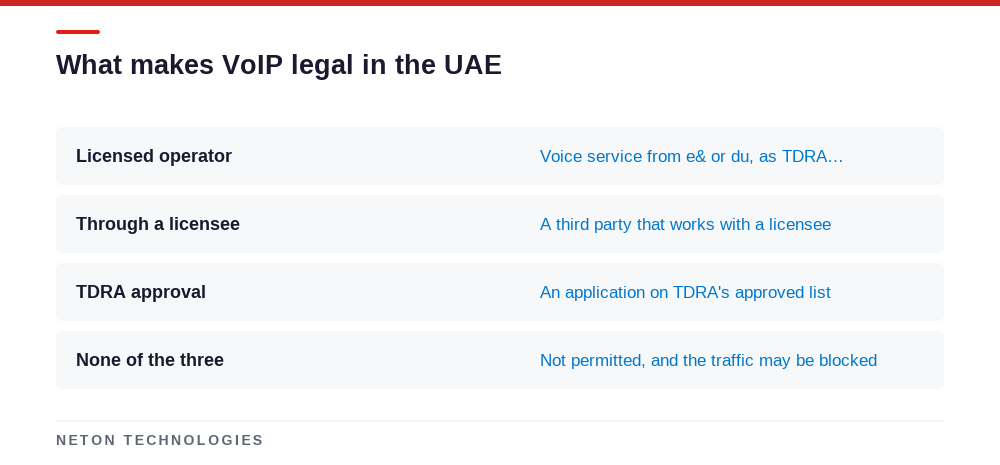
Yes, for business use VoIP is legal in the UAE when the service comes from a licensed operator (e& or du), from a provider working with one, or from an application TDRA has approved. VoIP calling from providers or apps that are none of these is not permitted. This is not legal advice.
Is VoIP legal in the UAE for businesses?
Yes, with a condition. VoIP is legal when the service comes from a licensed operator, from a third party working with one, or from an application TDRA has approved. TDRA is the UAE telecoms regulator. Its FAQs say that licensees are allowed to provide VoIP services, and that third parties can provide them by working with a licensee or obtaining TDRA approval.
The condition is the whole story. The question is rarely "VoIP or not". It is "who provides the service". A normal business phone system that gets its calls from an e& or du trunk is on the allowed side. An app or provider outside the UAE licensing framework is not.
This article reports what TDRA, du and Microsoft publish. It is not legal advice. Check your own setup with TDRA or your operator.
What does TDRA's VoIP policy actually say?
TDRA treats VoIP as a regulated telecommunications service. Its FAQ says VoIP services are considered telecommunications services, and that offering them to subscribers is a regulated activity that requires a licence or an exemption. The FAQ names the VoIP Regulatory Policy version 2.0, issued 30 December 2009, as the specific policy.
Four points from the FAQ matter to a business:
- Licensees may provide VoIP. That includes voice as a feature of a connectivity service used for internal communications.
- Third parties can provide VoIP too. They need to work with a licensee or hold TDRA approval.
- Internet voice and video calls from third parties are in scope. TDRA says they are a regulated activity that must be provided by a licensee.
- International providers are not licensed in the UAE to provide VoIP services. The FAQ says they must work with a licensee to terminate VoIP traffic to the UAE.
TDRA also says the policy does not stop you installing VoIP hardware and software in a private network, as long as the installer is not itself providing VoIP services. Hardware still needs TDRA type approval, so ask your supplier to confirm it.
What can a UAE business use for VoIP?
Four options sit on the allowed side. All four depend on a licensed operator somewhere in the chain. The comparison table at the end of this article sets them against the restricted options.
A SIP trunk from e& or du. A SIP trunk carries your business calls over IP instead of copper lines. du publishes a Business SIP Trunk with 10 to 100 channels, per-second billing and a 12-month contract. The same page says du does not provide a PBX, so the trunk and the phone system are separate purchases.
A cloud PBX running on a licensed trunk. A cloud phone system is software that handles extensions, queues and call routing. The calls to and from public numbers still travel over the licensed carrier. A business phone system in Dubai built on Wildix works this way, with the numbers staying with your e& or du account.
Microsoft Teams Phone through Direct Routing. Microsoft's UAE availability page says Calling Plans are not available to purchase in the UAE. Microsoft's Direct Routing plan says Direct Routing lets organisations use their existing PSTN carriers through a supported, customer-provided session border controller. Our guide to Microsoft Teams Direct Routing in the UAE covers the setup.
Approved applications. TDRA's Internet Guidelines page keeps a list. The general list at the time of writing includes Microsoft Teams, Skype for Business, Zoom, Cisco Webex, Slack, Avaya Spaces, BlueJeans, BOTIM and others, with Google Meet marked as meetings only. A separate telehealth list sits below it.
Which apps has TDRA approved?
TDRA publishes the list itself, and it is the only list worth trusting. The approved list on the Internet Guidelines page names the general applications above and a set of telehealth applications. The page also says TDRA may grant a VoIP exemption at its sole discretion, taking user and market demand into account.
Two cautions apply. First, the list can change, so check it on the day you decide. Second, an app being approved for calling does not mean it supplies a UAE phone number. A Teams or Zoom call between users is one thing. A call from Teams to a mobile number on e& is carried by a licensed carrier, which is why Direct Routing needs a trunk.
TDRA also issued a 2020 statement making a set of remote-work and learning applications available "exceptionally and until further notice". Do not read that statement as a general approval of every calling app.
What is not allowed?
Three things are on the restricted side, according to TDRA's FAQ.
- Unlicensed VoIP software and apps. For software bought from abroad, the FAQ says it is "very likely" illegal to use it unless a licensee provides it, a licensee works with the provider, or TDRA has approved it. TDRA urges people not to use such software.
- Call-back services from unlicensed providers. The FAQ treats call-back VoIP services as a regulated activity that a licensee must provide.
- Foreign providers terminating traffic on their own. International providers are not licensed in the UAE to provide VoIP, and must work with a licensee.
For users, TDRA's FAQ adds that people using unlicensed VoIP services may be committing a criminal offence, unless an exemption or approval applies. We do not interpret penalties. If you are unsure whether a tool you already use is covered, ask TDRA or your operator before keeping it in production.
How do licensed operators enforce this?
Licensees block traffic from VoIP applications that are not compliant. TDRA's Internet Guidelines say licensed service providers are obliged to block such traffic, and the FAQ says licensees "will probably block your illegal traffic". The UAE government portal names Etisalat (now e&) and du as the licensed internet service providers in the UAE.
For a business, blocking is also a reliability problem. A calling tool that works in a trial, or from a foreign network, may stop working on a UAE connection. It is a reason to design the phone system around the licensed route from day one.
How should you set up legal business calling in the UAE?
Start from the licensed trunk and build outward. Five steps cover most offices.
- Order the numbers and trunk from e& or du. Numbers are issued by the licensee against your trade licence. Ask the operator for the trunk specification before choosing a phone system.
- Choose the phone system. Cloud PBX, on-premise PBX or Microsoft Teams Phone all connect to the trunk. Compare them against how your staff actually work.
- Add a session border controller where needed. A session border controller sits between the trunk and the phone system. Microsoft says Direct Routing works only with certified SBCs, and TE-SYSTEMS anynode appears on that list.
- Check every calling app against TDRA's list. Do this before staff install them on company devices, including meeting tools, and repeat it when you add a new tool. Keep a dated note of what you checked.
- Write the setup down. Record who the licensed provider is, which apps are approved and who owns each decision, so an audit or a new IT manager can see it quickly.
If the calls are marketing calls, separate rules apply. The Do Not Call Registry (DNCR) rules are a different regime from the VoIP policy, so check them separately before any outbound campaign.
What is different in the UAE?
The UAE keeps voice services inside a licensing framework, so global VoIP advice often does not fit. In many countries you can buy numbers and minutes online from any provider. In the UAE, TDRA's FAQ says international providers are not licensed to provide VoIP services and must work with a licensee.
That is why Microsoft Calling Plans are not sold here, and why UAE Teams deployments use Direct Routing. It is also why overseas cloud dialler or contact-centre tools usually need a UAE carrier path. Ask any vendor, in writing, how its calls reach UAE numbers and which licensee carries them. A vendor that cannot answer that question has told you something useful.
Microsoft's PSTN connectivity page describes Direct Routing as the model where you can use any PSTN operator, through a certified SBC. In the UAE, that operator is e& or du.
How can NETON help?
NETON delivers business telephony in the UAE: Wildix, Microsoft Teams Direct Routing, SIP trunk integration and SBCs. We can map your current calling tools against the licensed route and tell you what to keep, change or retire. Contact us through the contact page with a short description of your setup. For rule questions, TDRA and your operator remain the authority.
Which VoIP options are allowed for a UAE business?
| Option | Status | What the source says |
|---|---|---|
| SIP trunk from e& or du | Allowed | Licensees may provide VoIP services (TDRA FAQ). du sells a business SIP trunk with 10 to 100 channels. |
| Cloud PBX or UCaaS running on a licensed trunk | Allowed when the voice service comes from a licensee | TDRA: third parties may provide VoIP by working with a licensee. Your numbers and calls stay with the licensee. |
| Microsoft Teams Phone through Direct Routing | Allowed when connected to a licensed carrier | Microsoft: Direct Routing connects a certified SBC to your existing PSTN carrier. Calling Plans are not sold in the UAE. |
| Microsoft Teams, Zoom, Cisco Webex, Slack and others | Listed by TDRA as approved applications | TDRA's Internet Guidelines page lists them. Google Meet is listed for meetings only. |
| Foreign VoIP apps or providers that are not licensed or approved | Not permitted | TDRA: use is likely illegal, and licensees will probably block the traffic. |
| Call-back services from unlicensed providers | Not permitted | TDRA: call-back services must come from a licensee, or a provider working with one or approved. |
Frequently asked questions
Is VoIP completely banned in the UAE?
No. TDRA's FAQ says licensees are allowed to provide VoIP services in the UAE, and that third parties may provide them by working with a licensee or with TDRA approval. What is not permitted is VoIP from a provider that is none of these.
Can I use WhatsApp or other free calling apps for my business?
Check TDRA's approved list rather than assuming. TDRA says third-party voice and video calls over the internet are regulated and must come from a licensee, a provider working with one, or an approved application. TDRA's list names some apps and omits others, and it can change.
Is Microsoft Teams calling legal in the UAE?
Microsoft Teams is on TDRA's list of approved VoIP applications. For calls to ordinary phone numbers, Microsoft does not sell Calling Plans in the UAE, so Teams Phone is connected to a carrier through Direct Routing and a certified SBC.
Is a SIP trunk the same as VoIP?
A SIP trunk carries business calls over IP, and in the UAE it is sold by the licensed operators. du's business SIP trunk page also says that "VOIP calls on SIP are currently not permitted in the UAE", so confirm with your operator exactly which uses its trunk covers before you design around it.
What happens if a business uses unlicensed VoIP?
TDRA says licensees will probably block the traffic, and that using unlicensed VoIP services may be a criminal offence unless an exemption or TDRA approval applies. Penalties and enforcement are matters for TDRA and legal counsel, so ask them rather than rely on a summary.
Where can I check the current rules?
Start with TDRA's FAQs and Internet Guidelines pages, which carry the VoIP policy and the approved application list. For your own setup, ask your operator or TDRA directly, because the list and the policy can be updated.
Sources
- Frequently asked questions (VoIP) — TDRA — 2026
- Internet Guidelines — TDRA — 2026
- Statement by Telecommunications Regulatory Authority — TDRA — 2020
- Internet Access Management Regulatory Policy — UAE Government — 2026
- Business SIP Trunk — du — 2026
- Availability in the United Arab Emirates (UAE) — Microsoft Learn — 2026
- PSTN connectivity options — Microsoft Learn — 2026
- Plan Direct Routing — Microsoft Learn — 2026
- Session Border Controllers certified for Direct Routing — Microsoft Learn — 2026
Setting up legal business calling in the UAE
Phone: +971 4 439 5754 | WhatsApp: +971 4 542 3229
Get a Free Consultation