Usually you do not port them at all. If you keep your carrier, e& or du re-points the same numbers to a SIP trunk on your new PBX or cloud system, which is a change on your existing account. Only if you also change carrier does TDRA's fixed number portability move your geographic and 800 numbers between e& and du.
Two different jobs that both get called "porting"
Moving to a new phone system and moving to a new carrier are separate decisions, and only the second one is a number port.
Your numbers belong to an account with e& or du. Your phone system, whether an old PBX in the comms room or a new cloud platform, only receives the calls that account delivers to it. Replace the phone system and keep the carrier, and the numbers never leave the account. The carrier simply delivers them somewhere new, usually over a SIP trunk instead of ISDN or analogue lines.
That is the common case. A business replacing an end-of-life PBX with a cloud or on-premise PBX usually stays with its carrier, because nothing about the new system requires a change.
Porting is when the numbers themselves move from one operator to the other, under TDRA's rules. You can do both at once, but treat them as two projects with two timelines.
Can fixed business numbers move between e& and du?
Yes. TDRA's fixed number portability lets you move an existing fixed line number from one operator to the other and keep it. It covers geographic numbers, and TDRA states it applies to most fixed line numbers in all emirates, the 02, 03, 04, 06, 07 and 09 codes, in both directions. It is open to enterprise customers as well as individuals.
The service is newer than many people assume. Mobile number portability arrived in 2013; fixed number portability followed in 2021, and more than 12,000 fixed numbers had been ported by the time TDRA announced toll-free portability the following year.
The rules that matter for a business, from TDRA's FAQ:
- The new operator runs the process. You apply to the operator you are moving to, and it deals with the old one. You do not need to start anything with your current carrier.
- Enterprise ports may take up to 10 working days. TDRA quotes about 3 working days for most individual customers, and up to 10 for enterprise.
- Porting happens during working hours only. You can submit the request at any time, but the switch itself is a working-hours event.
- There is a port-back window. You can return to the old operator within 7 working days of a successful port-out.
- The new operator must be able to serve your site. It has to provide the service over its own network or through bitstream where that applies. If it cannot, it may not accept you.
- Bundles break. If your line is part of a bundle with non-voice services such as internet, porting cancels the non-voice part.
- Debts follow you. You can port with an existing contract or open bills, provided the line is not suspended, but if you do not settle with the old operator the new line may be disconnected until you do.
e& adds two limits on its own fixed number portability page: you can only switch within the same emirate, because each emirate has its own area code, and the move is subject to e& network availability. It quotes 3 to 10 business days depending on the product, and says it activates the new service before the old one is terminated.
The bundle rule catches businesses out. If your internet and phone lines sit on one bundle, porting the numbers away can take the internet with them.
Keeping your carrier while changing the phone system
If you stay with e& or du, there is no TDRA process. You place an order on your existing account to deliver the same numbers to the new system, normally as a SIP trunk. This is how most moves to a cloud platform such as Wildix, or to a new IP PBX, actually happen.
What you ask the carrier for:
- The trunk itself, with the number of simultaneous channels you need.
- The full list of numbers on the account, mapped to the trunk, including ranges and any numbers you have forgotten about.
- The connection details your phone system will need: the proxy address, authentication credentials and how the carrier presents calling and called numbers.
- A cutover date, and whether the carrier can run the old lines and the new trunk side by side for a period.
On the phone system side, the configuration is short once the carrier details exist. Wildix's trunk settings guide lists what a SIP trunk needs: the authentication login and password from the carrier, the from-user and from-domain, the proxy address, a dialplan procedure for routing incoming calls (usually "main"), and a country code used for number normalisation. That last field matters in the UAE, because inbound numbers have to be matched consistently whether the carrier sends them in local or international format.
Wildix's list of supported VoIP operators covers North American and European carriers; UAE carriers are not on it. A UAE trunk still works, but the settings come from the carrier's technical sheet and are proved with test calls.
What to prepare before you start
The documents depend on the path, and on whether you are a new customer of the operator.
For a port to the other carrier, TDRA says you register as a new customer with the new operator. For 800 numbers it names the documents: the trade licence and establishment card. The most common reason for rejection is not a missing document but a mismatch. TDRA lists incomplete details, details that contradict the old operator's records, and a suspended line as grounds for refusal.
A practical pack for either path:
- Trade licence and establishment card, matching the legal entity on the current account.
- Your latest bill from the current carrier, so the account number, company name and address are copied exactly.
- A complete number inventory: every main number, direct-dial number, range, fax line, 800 number and any number used by an alarm, lift or door entry system.
- The authorised signatory for the account, and their contact details.
- A list of what else is on the account, especially internet and bundles, so nothing is cancelled by accident.
International guides often tell you to sign a letter of authorisation template. Microsoft's number transfer process works that way, but it is not the UAE process, and the UAE is not among the countries it lists. Use the forms the e& or du account team gives you.
The cutover sequence that keeps calls flowing
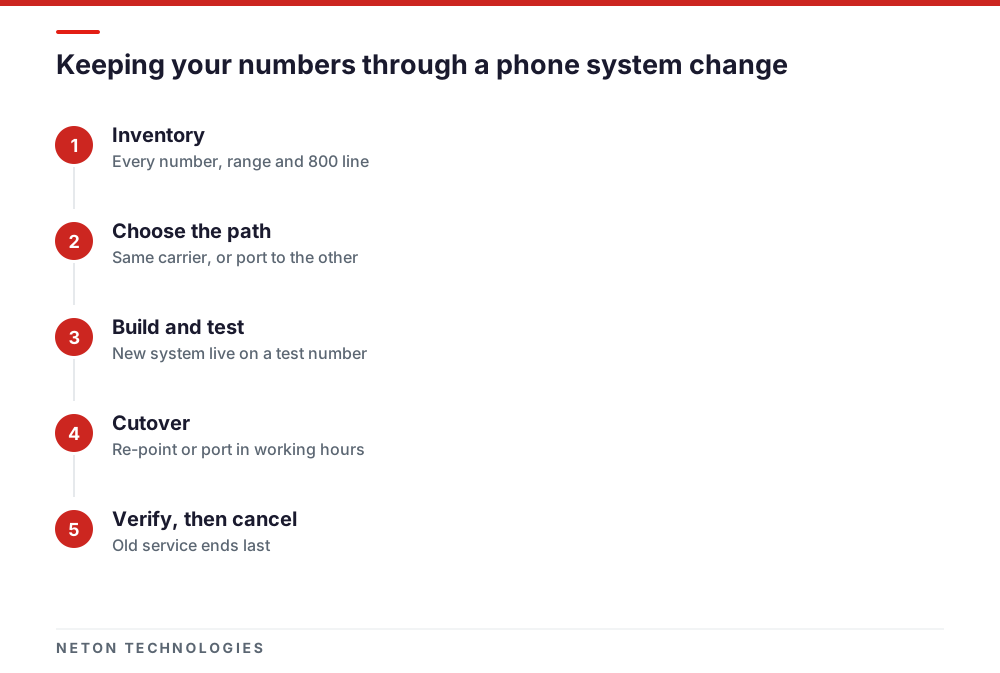
Lost calls usually come from doing things in the wrong order, not from the port itself. This sequence works for both paths:
- Inventory and test plan. List every number and decide where each one should ring on the new system. Write down a test call for each.
- Build the new system first. Configure users, ring groups, auto attendants and call routing while the old system still carries live traffic.
- Prove it on a test number. Ask the carrier for one temporary number on the new trunk, or bring a single low-risk number across first, and test inbound, outbound, caller ID and transfers.
- Schedule the cutover in working hours. TDRA's ports run during working hours only. Have someone at the carrier reachable on the day.
- Keep the old service live. Do not cancel the old lines, the old PBX or the old contract until every number has been tested on the new system.
- Test every number after the switch. Call each one from outside, including the 800 number and any fax or alarm line.
- Cancel last. Only then terminate the old service. If you ported, TDRA's 7 working day port-back window is your safety net.
The same discipline applies to any PBX upgrade: the old system is your fallback until the new one has carried a full working day.
DID ranges, 800 numbers and 600 numbers
DID ranges are geographic numbers, so they fall under fixed number portability if you change carrier. Port the whole range, including numbers nobody currently uses, and list every number explicitly on the request rather than relying on a description of the range. If you keep your carrier, the range simply moves to the SIP trunk; confirm the carrier maps the full range, not only the numbers it sees in use.
800 toll-free numbers became portable when TDRA extended the service in October 2022, as also reported by WAM. TDRA's FAQ puts a toll-free port at about 5 working days, with possibly a little loss of service during the transition. Two conditions are stricter than for fixed numbers: the line must not be suspended, and the bills must have been paid before their due date.
600 numbers are not covered by either of TDRA's portability FAQs, which deal with geographic and 800 numbers. Do not assume a 600 number can move between carriers. Ask the carrier that holds it, in writing, before you plan around it. If you keep that carrier, the 600 number can usually be pointed at the new system like any other number on the account.
Mobile numbers used as business lines are covered by separate mobile number portability, in place since 2013.
What is different in the UAE
Three things set the UAE apart from the porting guides written for the US or Europe.
Your numbers stay with a licensed operator. TDRA treats VoIP services as telecommunications services that licensees provide, or that third parties provide with a licensee or with TDRA approval. Fixed number portability moves numbers between du and e&, the operators named in TDRA's examples. You cannot port a Dubai number to an overseas cloud provider the way you might port a London number to a UK one.
Microsoft Calling Plans are not an option for UAE numbers. Microsoft's porting process into Teams lists the countries it supports, and the UAE is not one of them. A business that wants Teams as its phone system keeps its numbers on an e& or du trunk and connects it through Direct Routing and a session border controller.
Geography still matters. Ports stay within an emirate, the receiving operator must be able to reach your building, and a bundle with internet breaks if you port. Check those three before choosing a carrier, because each can rule a port out.
Elsewhere in the GCC, each country runs its own scheme under its own regulator. Qatar, for example, launched fixed number portability in March 2020. A regional rollout needs the rules for each country checked separately.
Choosing the path
If the project is about the phone system, keep the carrier. It removes the TDRA timeline, the bundle risk and the location check, and turns the number move into a routine change order.
Port only when there is a carrier reason: coverage at a new site, commercial terms or service quality. Then start the port request early and align it with the go-live of your new business phone system.
Keeping your carrier compared with porting to the other carrier
| Same carrier, new phone system | Port to the other carrier | |
|---|---|---|
| What it is | A change order on your existing account | A TDRA fixed or toll-free number portability request |
| Who you ask | Your current e& or du account manager | The new operator, which handles the old one |
| Numbers covered | Whatever is on the account | Most geographic numbers (02, 03, 04, 06, 07, 09) and 800 numbers |
| Published timeline | Set by your carrier's order process | Up to 10 working days for enterprise fixed numbers; about 5 for 800 |
| Bundled services | Usually unaffected | Non-voice parts of a bundle are cancelled |
| Location limit | None beyond your current service | New operator must be able to serve your site |
| Typical case | Moving to a cloud PBX, Wildix or a new IP PBX | Changing carrier for commercial or coverage reasons |
Frequently asked questions
Can I keep my office landline number if I move from e& to du, or du to e&?
Yes, in most cases. TDRA's fixed number portability lets business and individual customers move geographic numbers starting 02, 03, 04, 06, 07 and 09 between the two operators. You apply to the new operator, and it must be able to serve your location.
Do I need to port my numbers to move to a cloud phone system?
Not if you stay with the same carrier. Your numbers stay on your e& or du account and are delivered to the new system over a SIP trunk, which is a change order rather than a port. Porting only enters the picture if you also want a different carrier.
How long does porting a business number take in the UAE?
TDRA says enterprise fixed number ports may take up to 10 working days, and 800 toll-free ports about 5 working days. Porting only happens during working hours. Plan the cutover around that window rather than a weekend night.
Can I port my 800 toll-free number?
Yes. TDRA added toll-free number portability in 2022, so a company can keep its 800 number while moving it between e& and du. The line must not be suspended, and bills should be paid before their due date, or the request can be rejected.
What can cause a number port to be rejected?
TDRA lists incomplete details, details that contradict the old operator's records, and a suspended line. For 800 numbers, overdue bills are also a reason. Make sure the company name and account details you give the new operator match your current bill exactly.
Will we lose calls during the move?
TDRA says there may be little or no interruption during a fixed port, and possibly a little loss of service for 800 numbers. The practical safeguard is sequence: build and test the new system first, keep the old service live until each number is verified, and keep the old system ready as a fallback.
Sources
- Frequently asked questions: Fixed Number Portability and Toll-free Number Portability — TDRA — 2026
- TDRA expands number portability services to include (800) toll-free numbers — Gulf News — 2022-10
- TDRA expands number portability services to include (800) toll-free numbers — WAM (Emirates News Agency) — 2022-10
- TDRA expands number portability services to include the 800 toll-free numbers — Zawya — 2022-10
- UAE telecom regulator confirms 1.7m mobile numbers were ported between Etisalat and du since 2013 — Gulf News — 2021-10
- Switch to e& internet: Fixed Number Portability — e& UAE — 2026
- ISDN - FXO - GSM - SIP Trunk Settings - Admin Guide — Wildix — 2026-04
- List of Wildix Supported VoIP Operators — Wildix — 2026-04
- Transfer phone numbers to Microsoft Teams — Microsoft Learn — 2026-10
- Plan Direct Routing — Microsoft Learn — 2026
- Over 2,000 fixed numbers ported between telecom service providers — Gulf Times (QNA) — 2020-09
Moving your numbers to a new phone system in the UAE
Phone: +971 4 439 5754 | WhatsApp: +971 4 542 3229
Get a Free Consultation