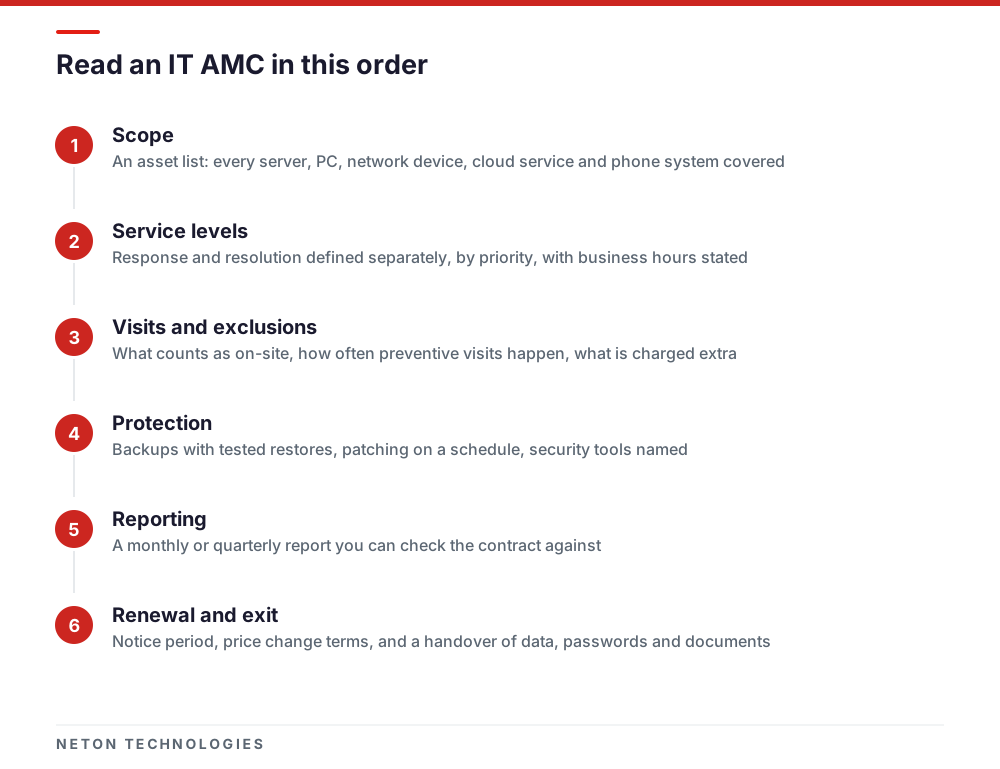
Check that the contract lists every device and service it covers, defines response and resolution times separately, says what counts as on-site, schedules preventive visits, names its exclusions, and covers backups with tested restores, patching, Microsoft 365 and your phone system. Then read the notice, renewal and exit terms, because that is where most disputes start.
Two AMCs with the same price and the same headline response time can cover very different things. Read these clauses before you sign, and ask for anything missing to be written in.
1. Scope: insist on an asset list, not "all IT equipment"
The scope clause decides every later argument, so it should be a list, not a sentence. Ask for a schedule that names what is covered:
- Users and devices. Number of users, PCs and laptops, printers, and mobile devices if they are managed.
- Servers and network. Each server, firewall, switch, Wi-Fi controller and access point, with location.
- Cloud services. Microsoft 365, any Azure or other cloud workloads, line-of-business software you rely on.
- Phones and other systems. The PBX or cloud phone system, CCTV, access control, if you want them in.
The schedule should say how it is updated when you add staff or equipment, and how that changes the fee. "All IT equipment at the premises" sounds generous until the provider decides your NAS or your second office was never part of it.
CISA's guidance for customers of managed service providers recommends specific, performance-related service level agreements rather than general commitments. An asset list is what makes that possible.
2. Service levels: response and resolution are different promises
Response time is how fast someone acknowledges a ticket and starts work. Resolution time is how fast the problem is fixed or worked around. Many AMCs promise only the first, which can be met in full while your email stays down all afternoon.
Ask for both, by priority, and check four details:
- How priorities are defined. "Business stopped" should be a defined category, not the provider's judgement on the day.
- What hours the clock runs in. Business hours, extended hours or 24/7, and whether UAE public holidays and the weekend count.
- How you log urgent faults. A phone line for priority one, not just an email inbox.
- What happens when targets are missed. Service credits, escalation to a named manager, or at least a written explanation in the monthly report.
3. On-site versus remote: define what "on-site" means
Most tickets are fixed remotely. The contract still needs to say when an engineer comes to you, how fast, and where.
- On-site response target. Next business day, a set number of hours, or something else, written per priority.
- Locations. Every office you want covered. If you have a branch in another emirate, check it is named.
- Caps. Some contracts limit on-site visits per year and charge after that. Know the number before you sign.
Check that the engineers are based in the UAE; nobody abroad can replace a failed switch in your comms room.
4. Preventive visits: a schedule and a checklist
The "maintenance" in annual maintenance contract is the preventive visit, and it is the clause most often left vague. Ask for a frequency (monthly, quarterly) and a checklist of what each visit covers, for example:
- Server and storage health, disk warnings, event logs and free space
- Backup job status and a sample restore
- Firewall firmware, rules review and expired accounts
- UPS battery state and comms room temperature
- Pending updates on servers and PCs
- Licence counts against users
Each visit should end in a short written report.
5. Exclusions, parts and project work
Good exclusions are short and specific; poor ones are open-ended enough to exclude anything inconvenient.
- Parts and hardware. Most AMCs cover labour only. If parts are included, the contract should say which parts and up to what value.
- Out-of-warranty devices. Will the provider still support them, and on what terms?
- Project work. Office moves, new servers and migrations are normally quoted separately. The contract should define where support ends and a project begins.
An end-of-life operating system is a common grey area. Microsoft's Modern Lifecycle Policy only keeps a product in support if customers stay current, and our guide to Windows 10 end of support shows what happens when they do not. Ask how the AMC treats unsupported software.
6. Backups and DR: tested restores, not just "monitored" jobs
A backup that has never been restored is an assumption. The contract should say how backups are run, monitored and tested, and how results are reported.
CISA recommends the 3-2-1 approach, three copies on two kinds of storage with one away from your premises, and advises testing that your team can restore data both fully and partially. The CIS Controls give data recovery its own control, aimed at restoring assets to a pre-incident and trusted state.
Write into the AMC:
- What is backed up, how often, and where the copies are kept.
- How often restores are tested, and that each test is recorded with how long it took.
- A disaster recovery test, at least yearly, against a written plan. NIST's contingency planning guide is a useful structure if you have nothing yet.
If your backups still run to an old NAS in the same room as the server, read why old NAS backups fail before you renew.
7. Security patching and endpoint protection
NIST describes patching as preventive maintenance for technology, which makes it a core AMC task, not an extra. The CIS Controls put it under continuous vulnerability management.
Check that the contract states:
- A patch schedule for servers, PCs and network devices, including firewall firmware.
- An emergency process for critical vulnerabilities, outside the normal cycle.
- The endpoint protection product, who licenses it, and who responds to its alerts.
- Reporting: which devices are patched, which are not, and why.
Patching is one layer of a wider picture covered in our guide to cybersecurity for UAE businesses.
8. Microsoft 365: say exactly what is covered
Microsoft runs the service; you are still responsible for what is in it. Microsoft's shared responsibility model says that for every cloud deployment type, you own your data and identities, including accounts and access management. Your AMC provider is usually the one doing that work for you, so list it: user setup and removal, licences, mailbox and SharePoint permissions, MFA and conditional access, and whether Microsoft 365 data is backed up. Microsoft sells Microsoft 365 Backup as a separate pay-as-you-go service, so it is not there by default.
Ask how the provider accesses your tenant. Microsoft recommends as few Global Administrators as possible and the least permissive role for each task. For partners, GDAP gives granular, time-bound access that the customer must explicitly grant. A provider asking for permanent Global Admin rights should explain why.
9. Phone system coverage
The phone system is often excluded without anyone noticing until it fails. If it belongs in the AMC, write it in: extension changes, call flows and IVR updates, handset faults, carrier line issues, and who talks to the vendor. If your business phone system is supported by a different company from your IT, make sure neither contract assumes the other covers the network between them.
10. Reporting
A monthly or quarterly report is how you check the contract is being delivered. It should show tickets by priority against the agreed targets, preventive visits completed, backup and restore results, patch status, and recommendations with a cost. CISA also recommends that customers require cybersecurity incident reporting from their provider. Agree the format before you sign.
11. Notice, renewal and price terms
Read the last page before the first:
- Term and auto-renewal. Does the contract renew automatically, and how far in advance must you give notice to stop it?
- Price changes at renewal. Capped, linked to scope changes, or open?
- Termination for poor service. Can you leave early if service levels are repeatedly missed?
- Prepaid fees. What happens to them if you leave early.
12. Data handover on exit
The exit clause matters most on the day you change provider. It should list what is handed over and by when: admin passwords and break-glass accounts, network diagrams and IP plans, licence keys and subscription records, backup access, firewall configurations, and documentation of anything the provider set up.
It should also commit the provider to removing its own accounts, remote tools and partner access. One Microsoft detail matters here: if the provider is your Microsoft 365 reseller, Microsoft says you cannot remove a reseller relationship yourself, so the exit clause should oblige the provider to release it.
What is different in the UAE
- Personal data rules apply to your provider's work. Federal Decree-Law No. 45 of 2021 sets the obligations of companies holding personal data to secure it and keep it confidential. Hunton's summary notes that personal data must be kept securely and may not be retained after the purpose of processing is fulfilled. Your AMC gives a third party access to that data, so include confidentiality, access controls and deletion of your data on exit.
- The weekend and public holidays. Check how the service hours handle the UAE working week and public holidays, especially for 24/7 cover.
- Multi-emirate offices. On-site cover in Dubai does not automatically mean on-site cover in Abu Dhabi or Sharjah. Name every location.
- Sector rules. If a free zone or sector regulator sets its own security or data requirements, ask how the AMC meets them.
Where NETON fits
NETON's IT support and AMC plans are built on the structure above: a helpdesk with Dubai-based on-site engineers, scheduled preventive visits, and backup verification, patching and Microsoft 365 support in every plan. Essential suits 5 to 15 users with business-hours helpdesk, next-business-day on-site response and quarterly visits. Business covers 15 to 50 users with a 4-hour on-site target and monthly visits. Enterprise is for 50 or more users, with a 24/7 helpdesk, a 2-hour on-site target and bi-weekly visits.
As a Microsoft CSP partner, Wildix Gold Partner and Sangoma partner, NETON can put Microsoft 365 and your phone system in the same contract as your servers and PCs, with backup on Iperius and Jotelulu and endpoint protection from ESET. Send us your current AMC and we will show you, clause by clause, what it does and does not cover.
IT AMC contract clauses: what to ask for and what to push back on
| Clause | What good looks like | Push back if |
|---|---|---|
| Scope | A named asset list and service list, updated when you add users or devices | It says 'all IT equipment' with no schedule attached |
| Response and resolution | Separate targets for each, by priority, with the hours they apply in | Only a response time is given, or 'best effort' for urgent faults |
| On-site support | A stated on-site response target and which locations are covered | On-site visits are capped, or charged after a small number per year |
| Preventive visits | A schedule and a checklist of what each visit does | Visits are 'as required' with no frequency |
| Exclusions and parts | A short, specific exclusions list; parts and labour priced separately and clearly | Parts are 'included' with no limits stated, or exclusions are open-ended |
| Backup and DR | Backups monitored daily, restores tested on a schedule, results reported | Backup is 'monitored' but restores are never tested |
| Patching and security | A patch schedule, emergency patch process and named endpoint tools | Patching is mentioned but not scheduled or reported |
| Microsoft 365 and phones | Named admin tasks covered, phone system changes included or priced | Cloud services and the PBX are silently out of scope |
| Exit | Data, passwords, documentation and admin access handed over within a stated period | No exit clause, or handover is charged at an undefined rate |
Frequently asked questions
What should an IT AMC include for a small business in the UAE?
At minimum, a helpdesk, on-site support with a stated response target, scheduled preventive visits, monitoring of servers and backups, patching and antivirus management, and Microsoft 365 administration. If your phones run on an IP PBX, include it too. Everything should be tied to a written asset list so both sides know what is covered.
What is the difference between response time and resolution time in an AMC?
Response time is how quickly the provider acknowledges and starts work on a ticket. Resolution time is how quickly the problem is actually fixed or a workaround is in place. A contract that only promises a response time can be met in full while your email stays down all day, so ask for both, by priority.
Are hardware parts usually included in an IT AMC?
Usually not. Most AMCs cover labour and leave parts and replacement hardware to be quoted separately or claimed under the manufacturer's warranty. If parts are included, the contract should say which ones, up to what value, and what happens with devices that are out of warranty.
How often should backups be tested under an AMC?
The contract should state a schedule, not leave it to discretion. CISA advises testing that your team can restore data both fully and partially. Ask for the results of each test in your regular report, including how long the restore took.
What should happen when we end an IT AMC?
The provider should hand over admin passwords, network diagrams, licence records, backup access and documentation within a stated period, and remove its own accounts and partner access. Check who your Microsoft 365 reseller is, because Microsoft says a customer cannot remove a reseller relationship itself.
Can NETON's AMC cover our phone system as well as IT?
Yes. NETON is a Wildix Gold Partner and a Sangoma partner, so phone system support can sit in the same AMC as servers, PCs, networks and Microsoft 365. That gives you one contract, one helpdesk and one asset list for both.
Sources
- CISA Insights: Risk Considerations for Managed Service Provider Customers — US Cybersecurity and Infrastructure Security Agency — 2021-09
- Back Up Business Data — US Cybersecurity and Infrastructure Security Agency — 2026-11
- Guide to Enterprise Patch Management Planning (SP 800-40 Rev. 4) — NIST — 2022-04
- Contingency Planning Guide for Federal Information Systems (SP 800-34 Rev. 1) — NIST — 2010-11
- CIS Critical Security Controls Version 8 — Center for Internet Security — 2026-11
- CIS Control 11: Data Recovery — Center for Internet Security — 2026-11
- CIS Control 7: Continuous Vulnerability Management — Center for Internet Security — 2026-11
- Shared responsibility in the cloud — Microsoft Learn — 2026-08
- Overview of Microsoft 365 Backup — Microsoft Learn — 2026-11
- About administrator roles in the Microsoft 365 admin center — Microsoft Learn — 2026-10
- Granular delegated admin privileges (GDAP) introduction — Microsoft Learn — 2026-04
- Add, change, or delete a Microsoft 365 subscription advisor partner — Microsoft Learn — 2025-07
- Modern Lifecycle Policy — Microsoft Learn — 2024-06
- Data protection laws — The Official Portal of the UAE Government — 2026-11
- Data Protection in the UAE: Game Changing Federal UAE Data Law — Hunton Andrews Kurth — 2021-12
Compare your current IT AMC against a clear, written scope
Phone: +971 4 439 5754 | WhatsApp: +971 4 542 3229
Get a Free Consultation